
Test Bay OS: standards-checked transformer testing and certificates
Transformer test bays still write readings in a register, work out pass or fail by hand and retype everything into each customer's certificate format. Test Bay OS judges every reading against IS and IEC standards as it is typed, works offline on a tablet, reads handwritten registers with AI, and issues signed, QR-verifiable certificates.
In short
Test Bay OS is a multi-tenant SaaS for transformer manufacturers, designed and built by Digital Web Weaver. A shared TypeScript standards engine corrects and judges each reading against IS 2026, IS 1180, IEC 60076 and IEC 61869 as it is entered, in the browser, on the server and offline on a React Native tablet app. Claude vision reads handwritten test registers, a calibration gate blocks expired instruments, and certificates render in any customer format with an approval chain, HMAC signature and QR code.
// the problem — the test bay still runs on paper
Why transformer testing is slow and risky
Every transformer that leaves a factory must pass winding resistance, ratio, insulation, losses, impedance, dielectric and more. Most Indian manufacturers still do the paperwork by hand.
Readings are written twice
Values go into a handwritten register on the shop floor, then get retyped into spreadsheets and Word templates, once for every customer format.
Pass or fail is worked out by hand
Resistances must be corrected to 75 °C, losses checked against guarantee plus tolerance, and star-rating caps and accuracy classes looked up. Mistakes are easy and hard to spot.
Calibration is a blind spot
Nothing stops a test with an instrument whose NABL calibration has lapsed, and an auditor can void the certificate.
History is scattered
When a customer asks for the record on a serial number years later, someone digs through files.
The bay has poor connectivity
Cloud tools that need a constant connection fail exactly where the testing happens.
// what we built — unit → guided session → live verdict → approval → certificate
The IS/IEC rulebook, built into the software
Screenshots show a fictional demo company, "Meridian Transformers Pvt Ltd". Every verdict and certificate shown was computed by the real engine.
01 · Guided test session
A live verdict on every reading
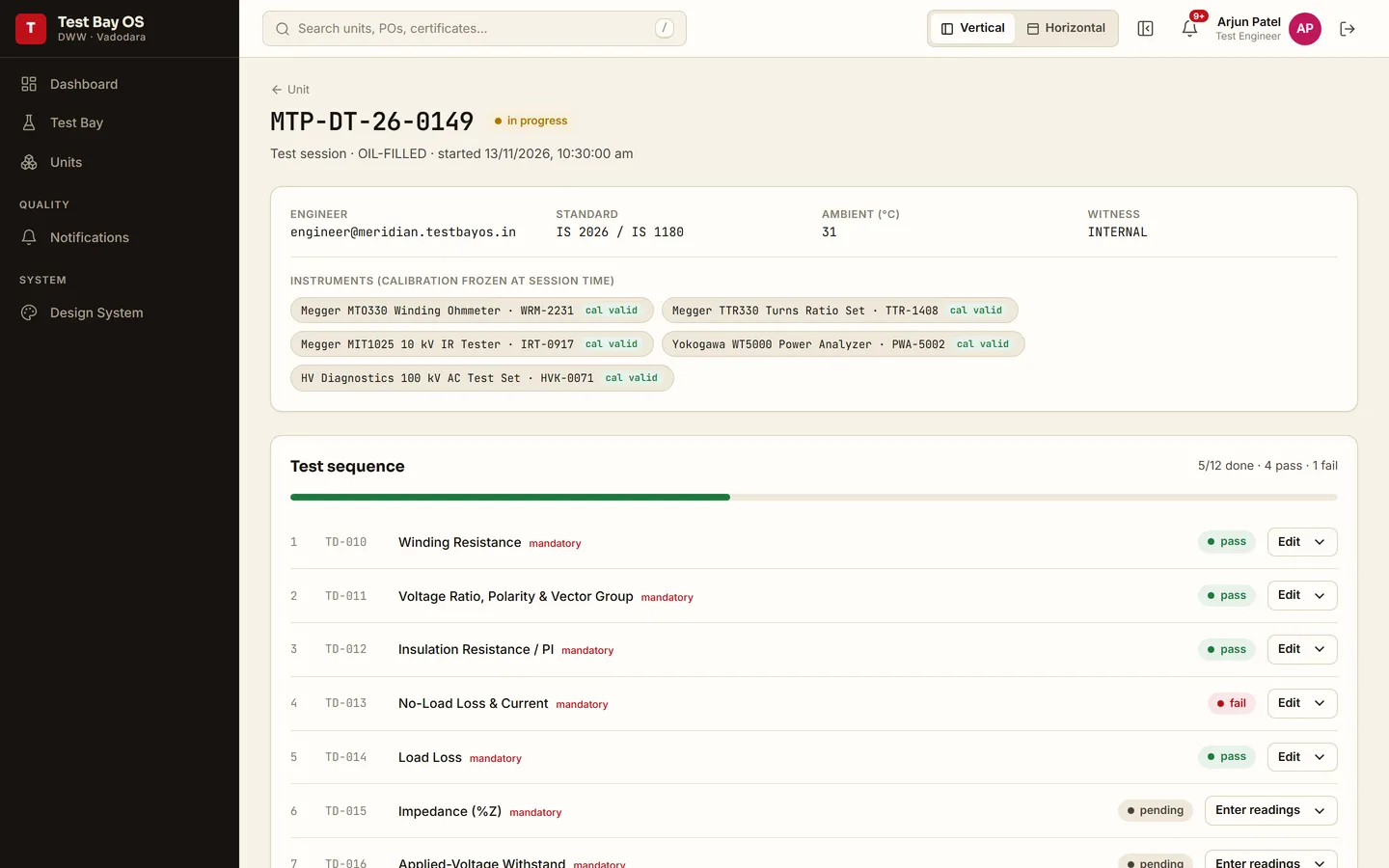
An engineer picks a unit and starts a session. The system resolves the test plan for that transformer type, freezes the instruments and their calibration status, and fills in the guarantees from the nameplate, so the engineer only types what they measure.
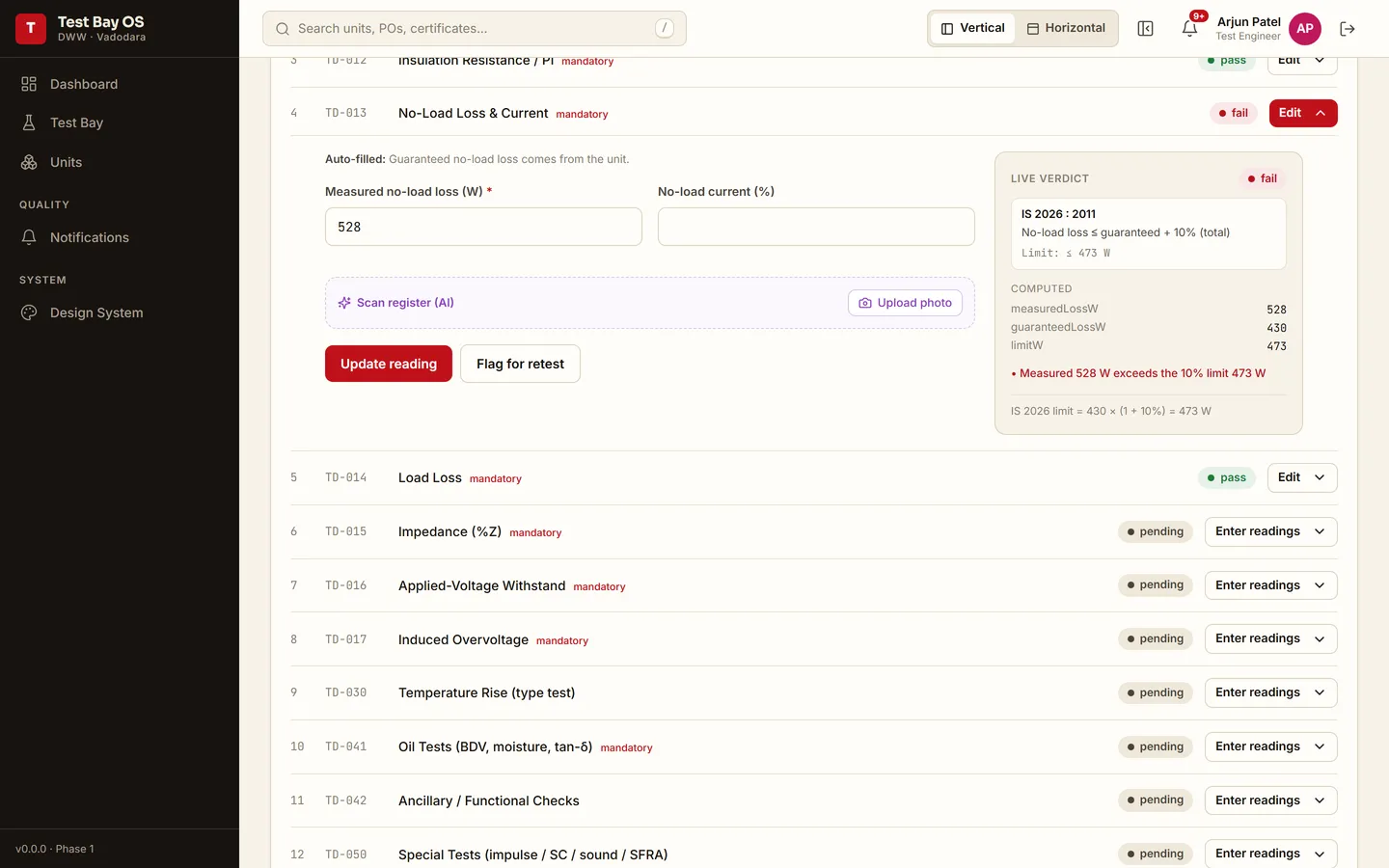
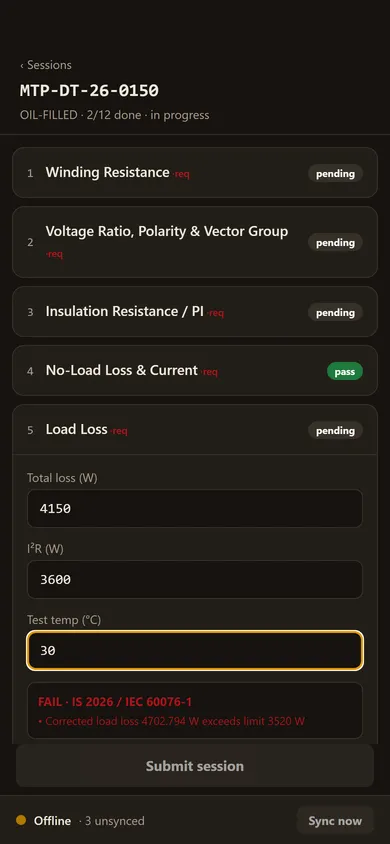
Each reading gets an instant pass or fail with the corrected values, the governing clause and the computed limit. Here a measured no-load loss of 528 W breaks the IS 2026 limit of 430 W + 10% = 473 W. Submission stays blocked until every mandatory test has passed.
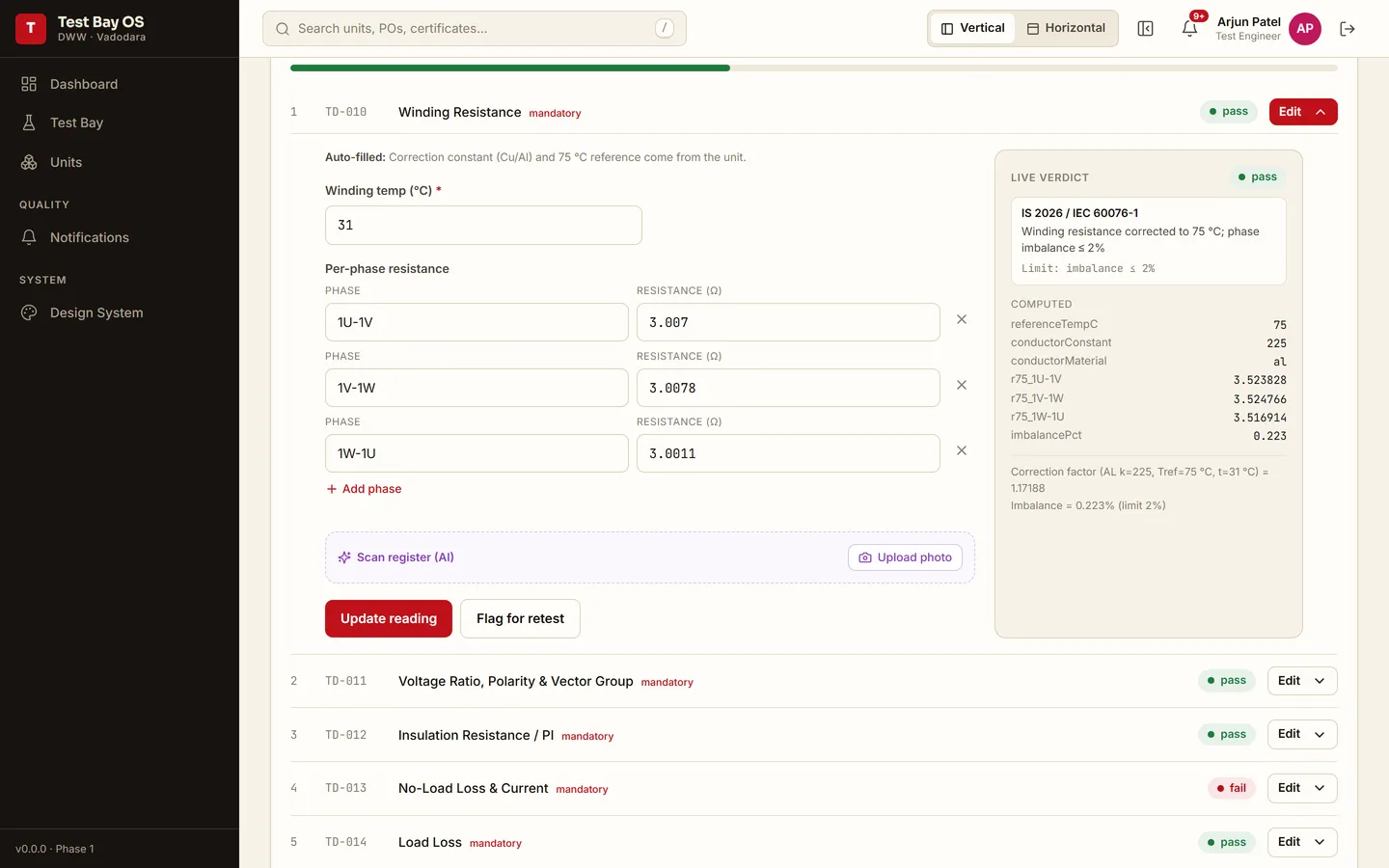
- Winding resistance corrected to 75 °C
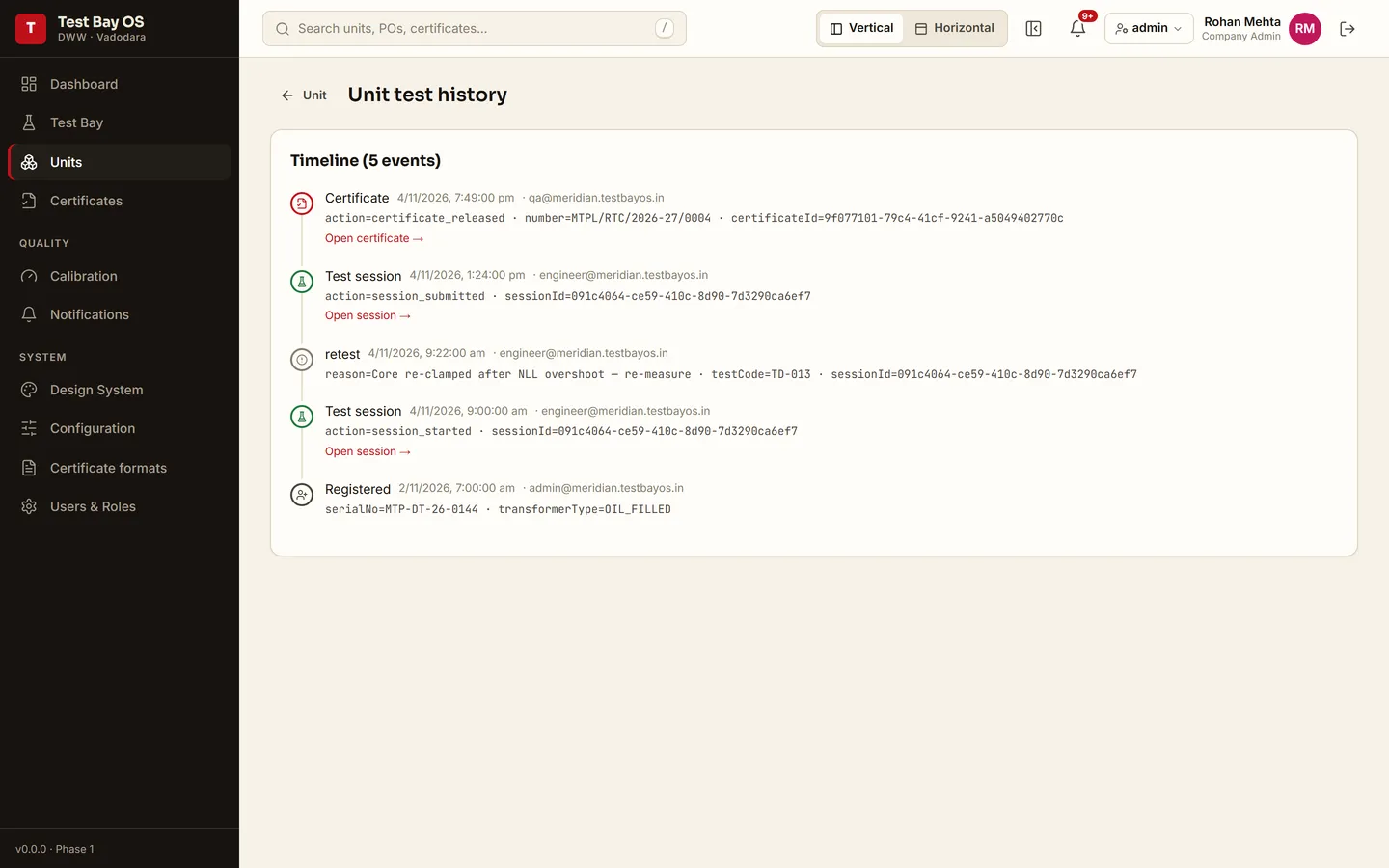
- Retests recorded with a reason
02 · Standards engine
One engine, three runtimes
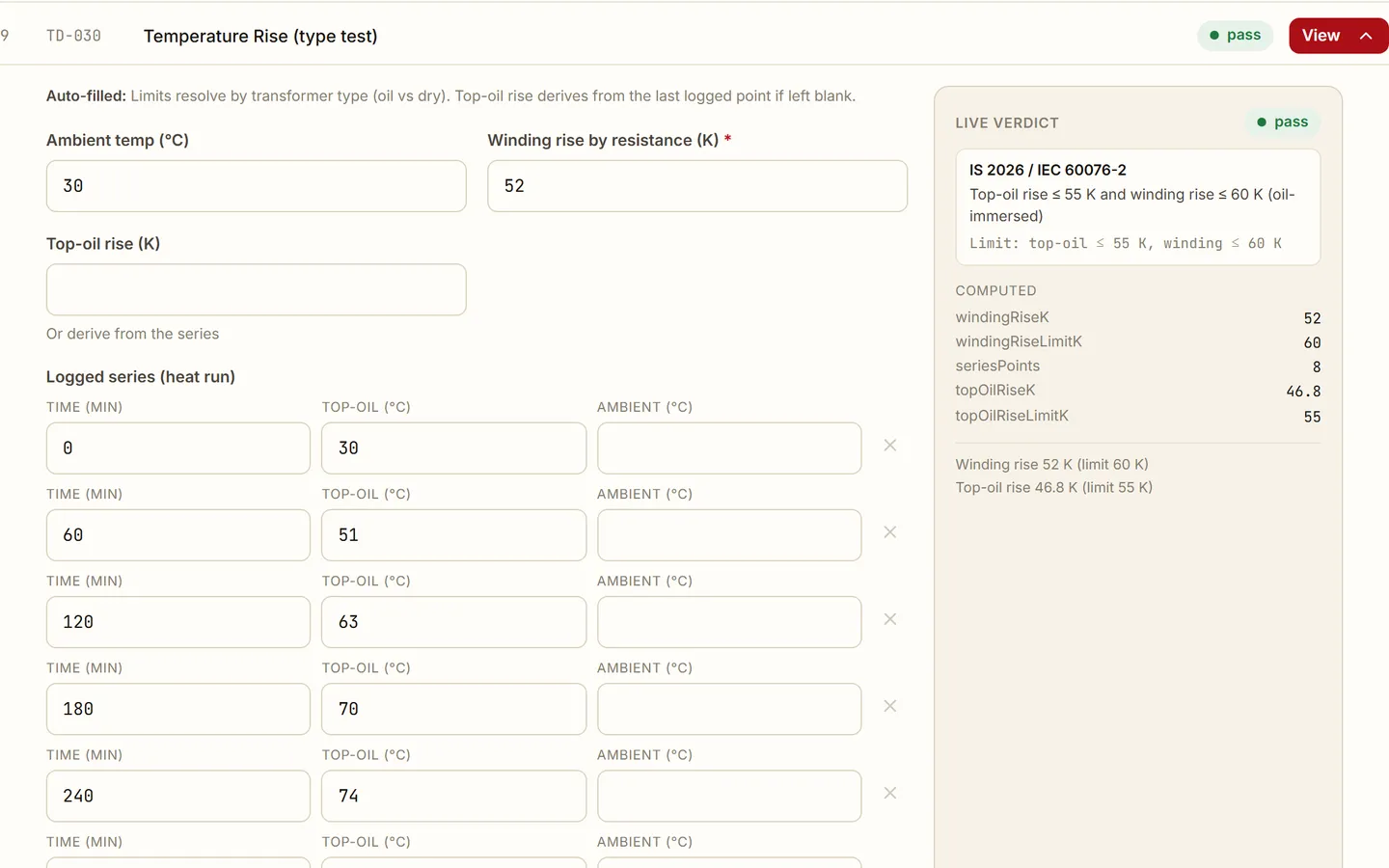
The standards engine is a pure, deterministic TypeScript package with 22 evaluators and 109 unit tests. The web app, the API and the offline mobile app all run the same code, so a verdict on a tablet with no network is identical to the server's.
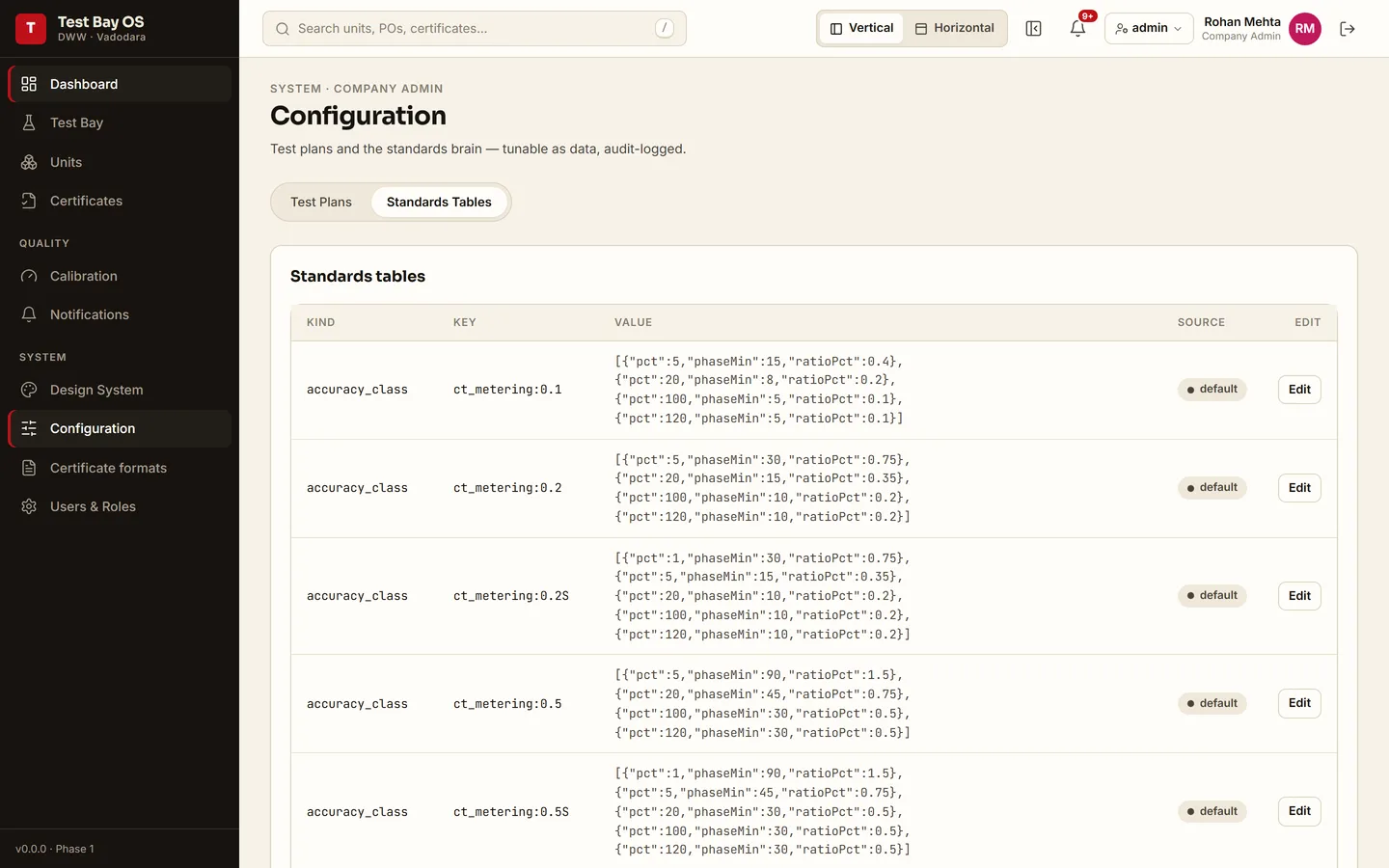
Correction constants, tolerances, star caps, dielectric levels and accuracy classes are stored as data. An admin can tune them per company, every change is audit-logged, and no redeploy is needed.
- IS 2026, IS 1180, IEC 60076, IEC 61869
- Every verdict cites its clause
03 · AI Scan-to-Certificate
A photo of the register becomes checked readings
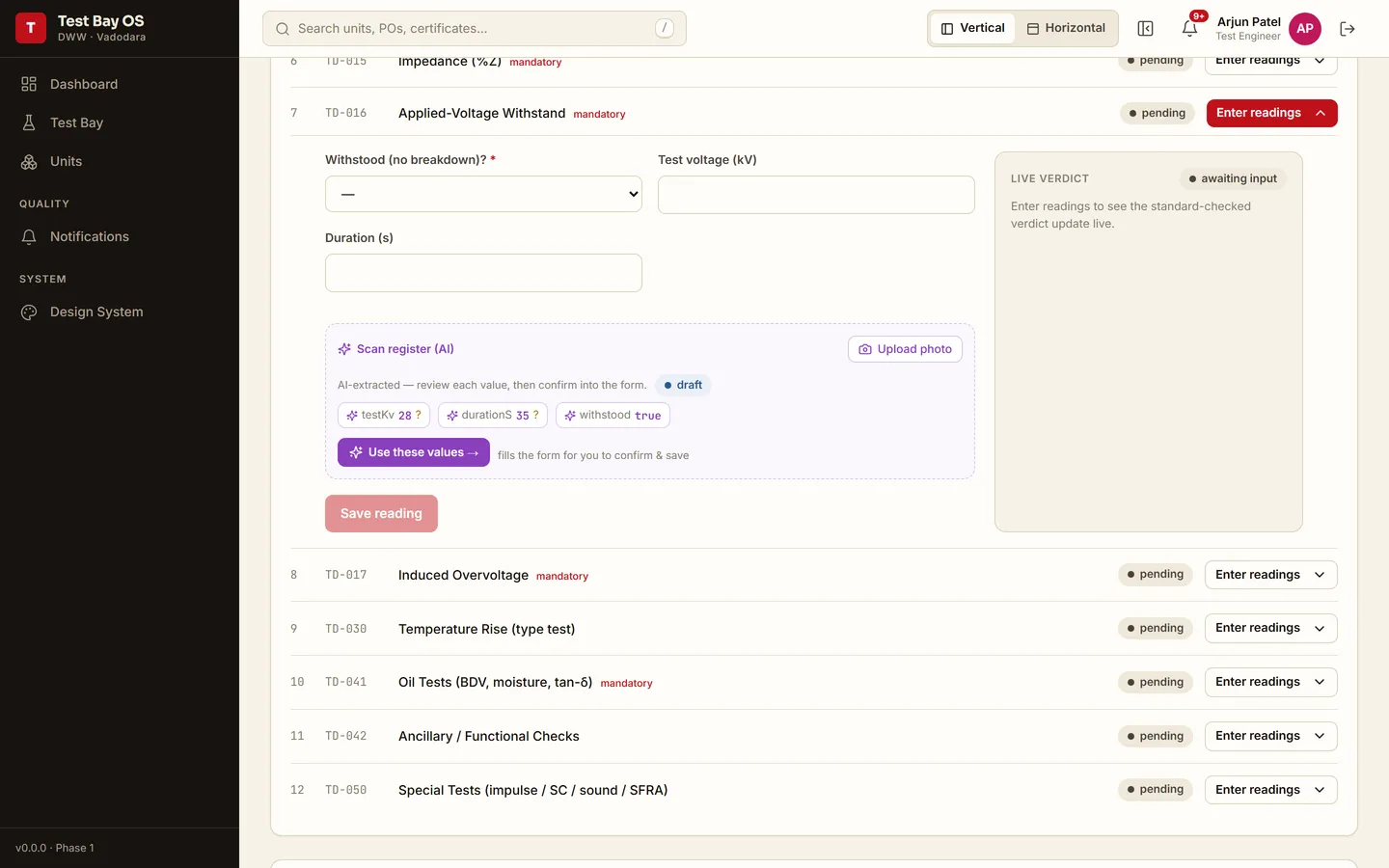
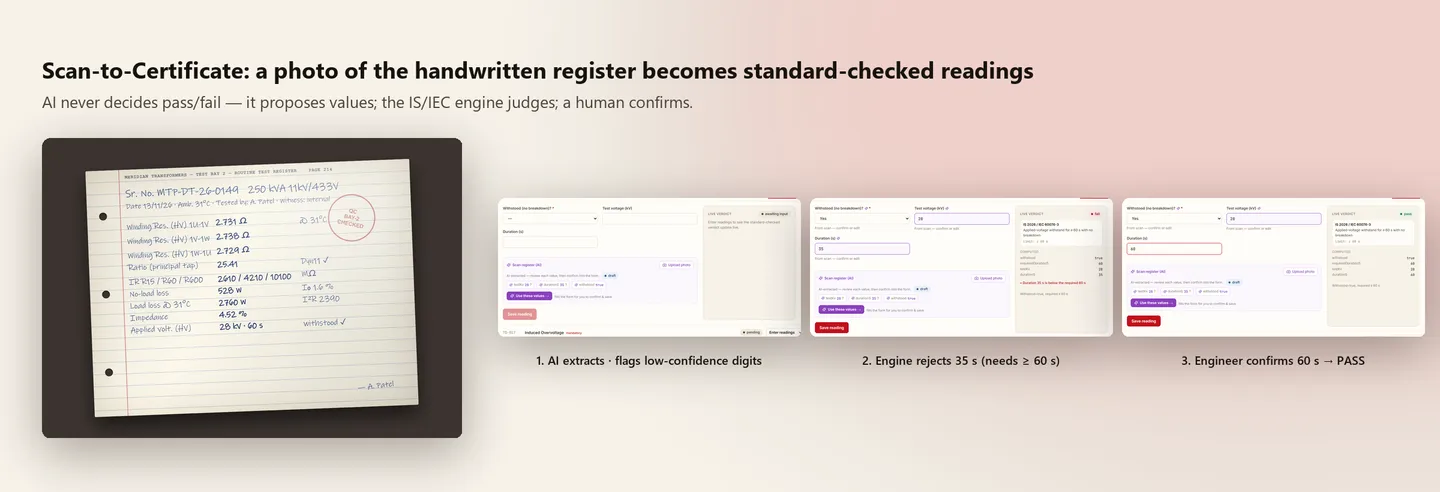
Many factories will keep the paper register for years, so Test Bay OS works with it. The engineer photographs the register page, and a Claude vision model reads the handwriting, maps each value to the test's fields and flags uncertain digits.
AI never decides pass or fail. Its values are marked with a violet ✦ and judged by the standards engine like any reading. Here the AI read a 35 s duration; the engine rejected it because the withstand test needs 60 s, and the engineer corrected it from the register.
- Confidence score on every value
- Photo-quality checks before extraction
04 · Offline-first test bay app
The whole session runs on a tablet with no network
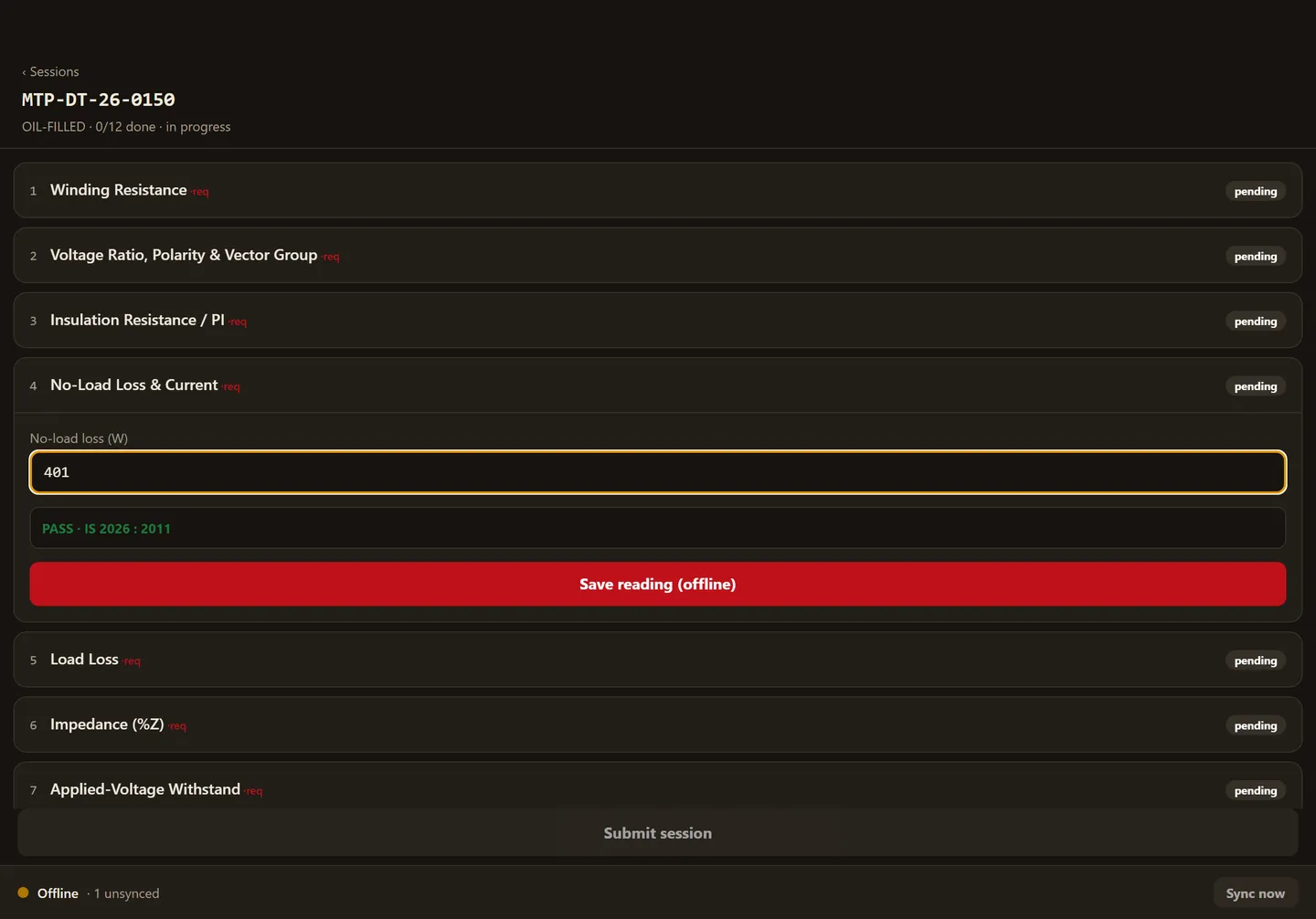
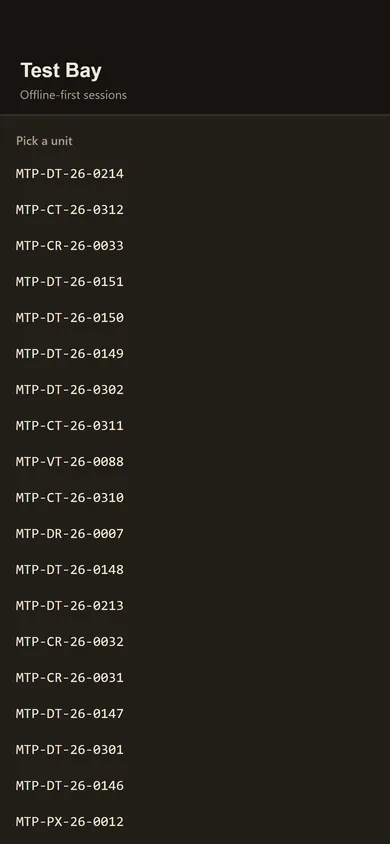
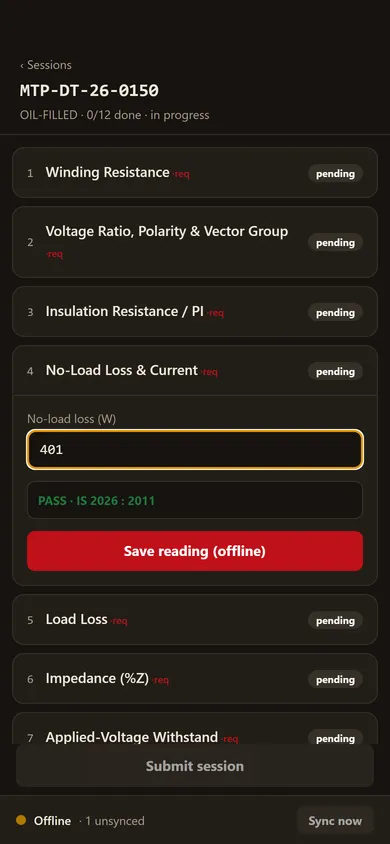
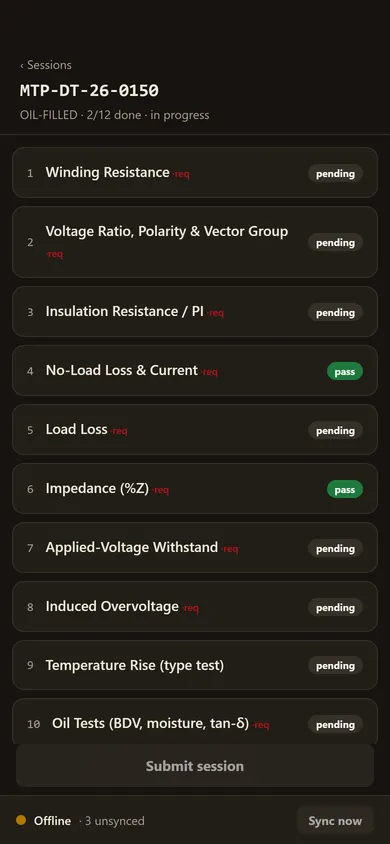
A React Native and Expo app caches units and test plans into on-device SQLite at sign-in. Starting a session, entering readings and submitting all happen locally, with verdicts from the same standards engine running on the device.
Every change goes into an idempotent outbox and syncs in order when the connection returns, so retries never create duplicates. A sync bar on every screen shows how many changes are waiting.
- Landscape tablet and phone
- Dark theme for the bay
05 · Certificates
Any customer format, audit-proof
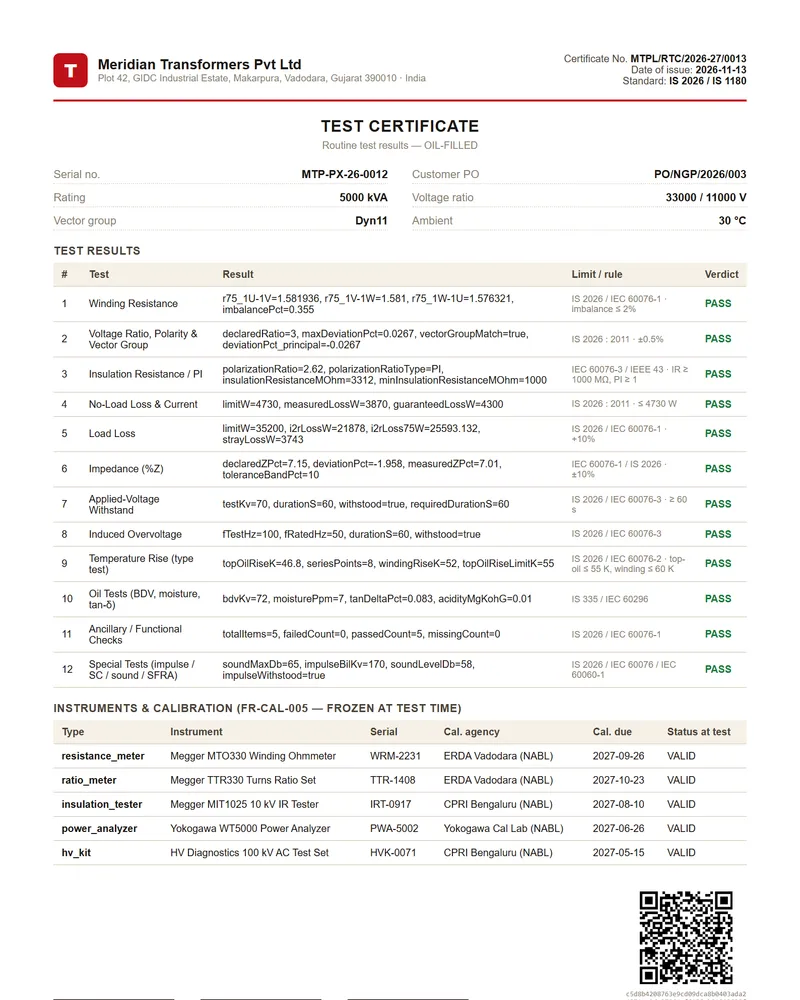
Certificates come from a generic document engine: an HTML template plus frozen data, rendered to a pixel-accurate PDF. The same session can produce an IS 2026 routine certificate, an IEC export report or a utility's own format.
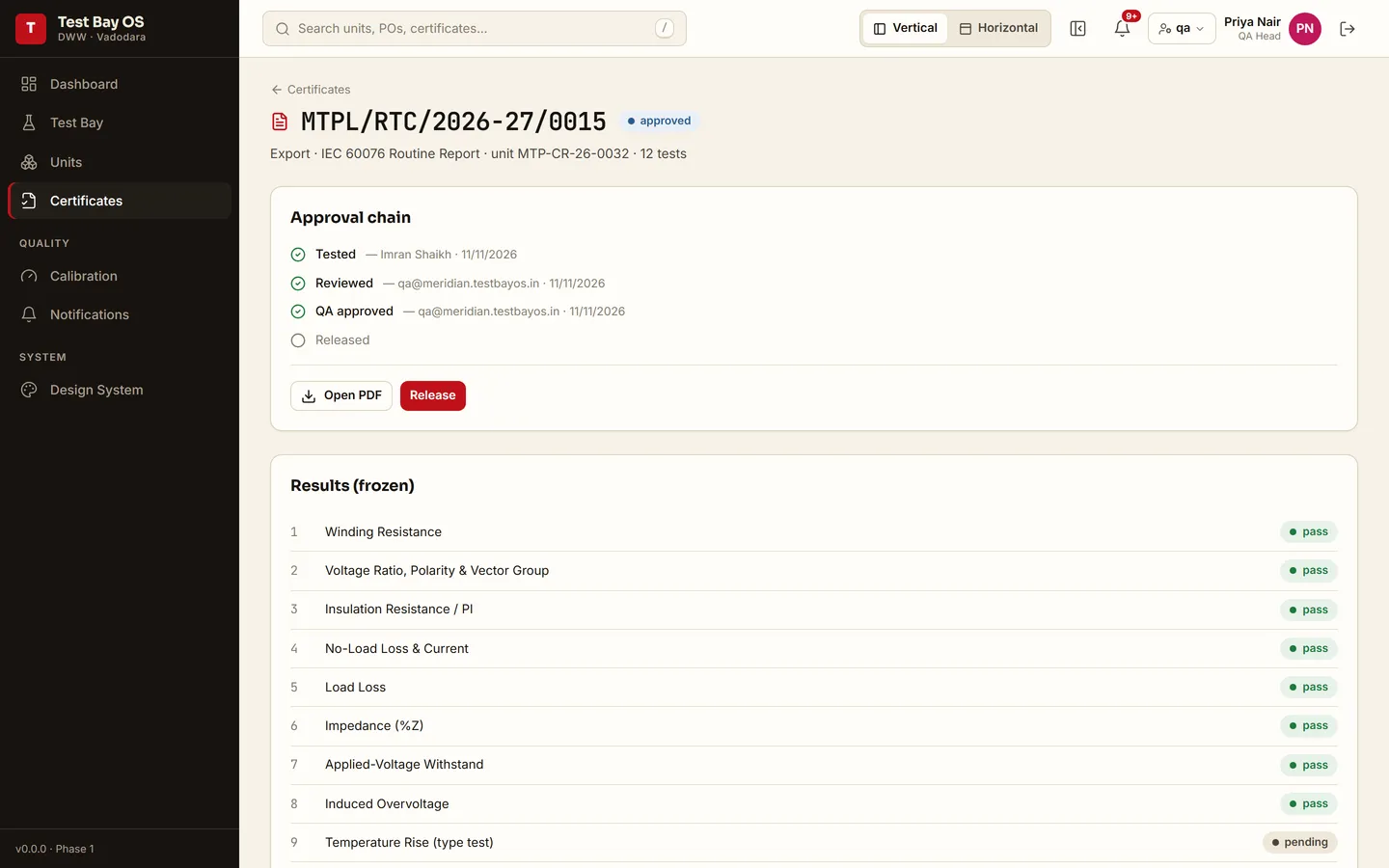
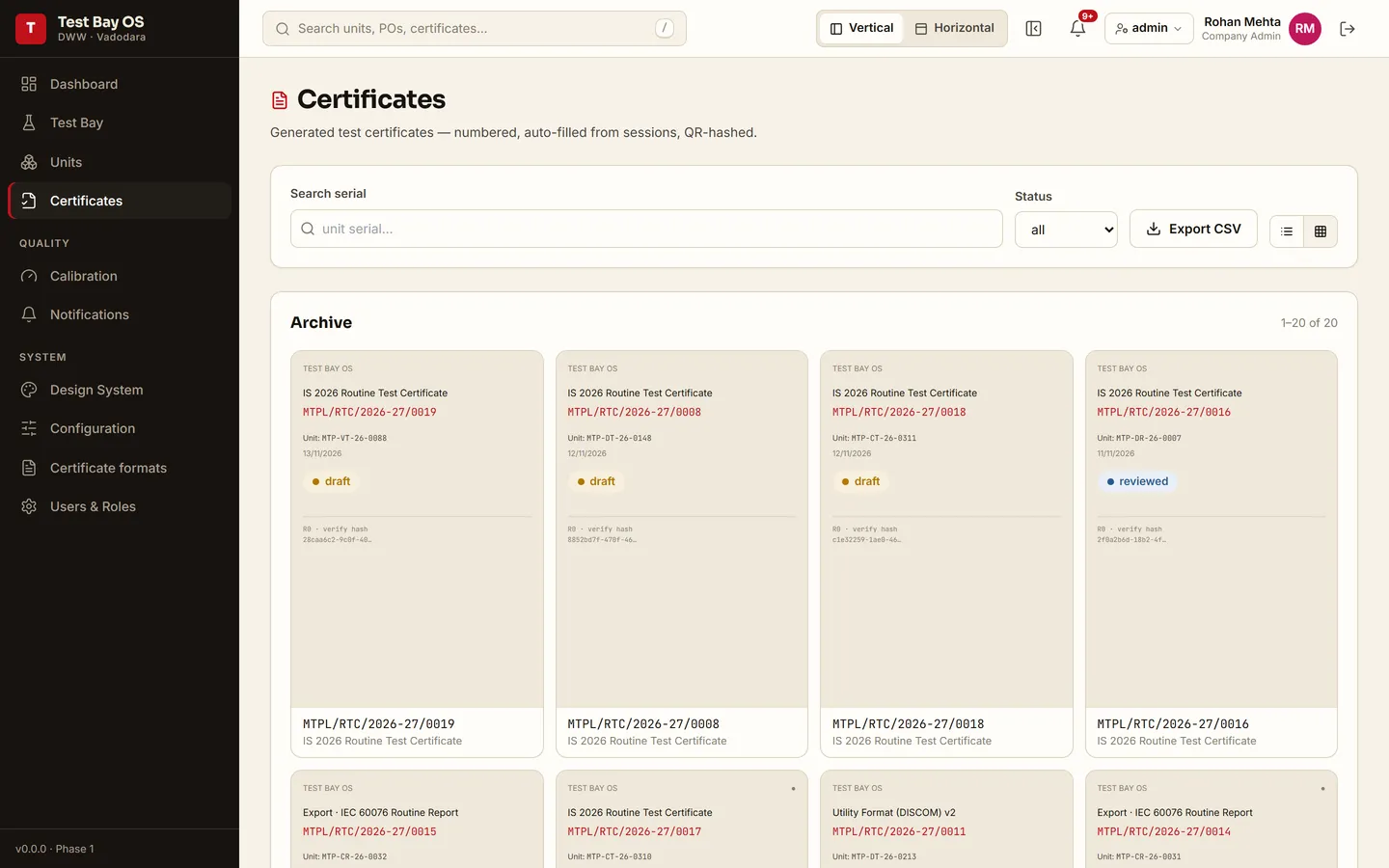
Numbers follow each company's pattern with Indian financial-year rollover. Every certificate goes draft → reviewed → QA approved → released, can't be changed after release, is corrected only by a numbered re-issue with a reason, and is HMAC-signed with a QR verification code.
- Customer formats as versioned templates
- Archive with filters and CSV export
06 · Calibration & safety
No reading from an expired instrument
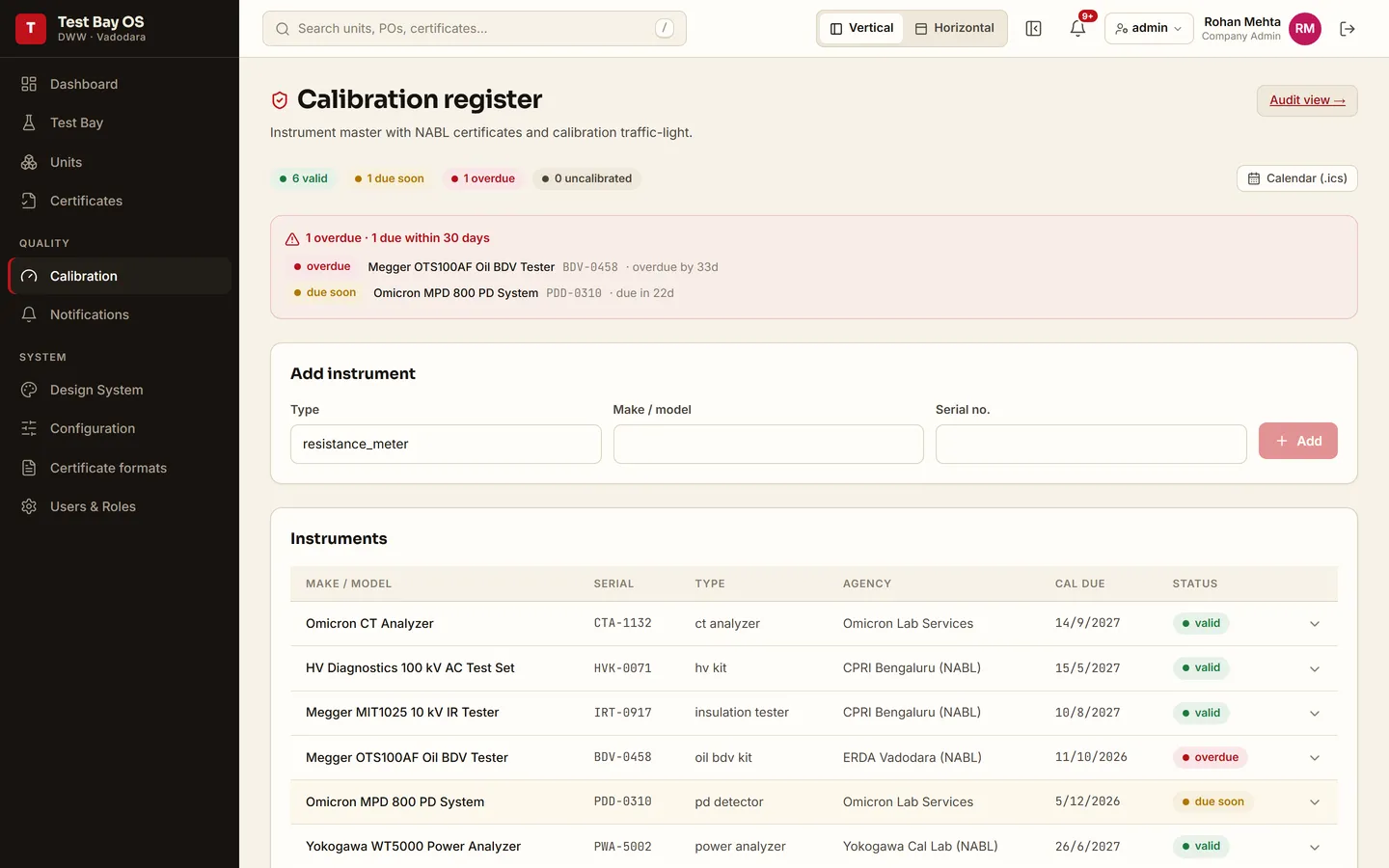
An instrument register holds make, serial number, calibration agency, due date and the NABL certificate. Instruments are marked valid, due soon, overdue or uncalibrated; overdue ones can't be selected for a session, and a daily job sends alerts. An audit view shows which instrument was used on which session.
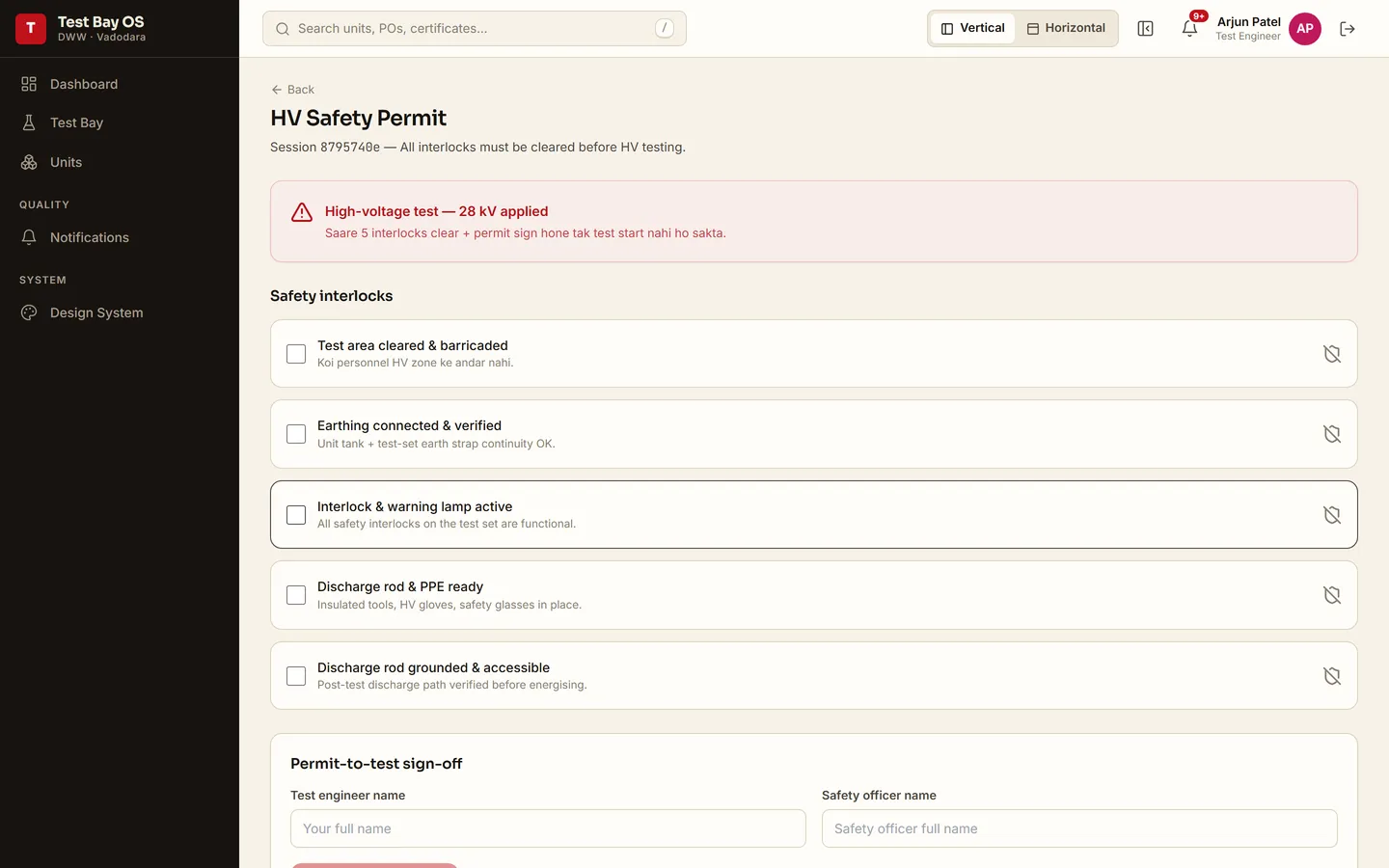
Before high voltage is applied, a permit-to-test with five interlocks must be confirmed and signed by a safety officer, with bilingual instructions for floor staff.
- Calibration frozen at test time
- HV permit-to-test
07 · Roles & administration
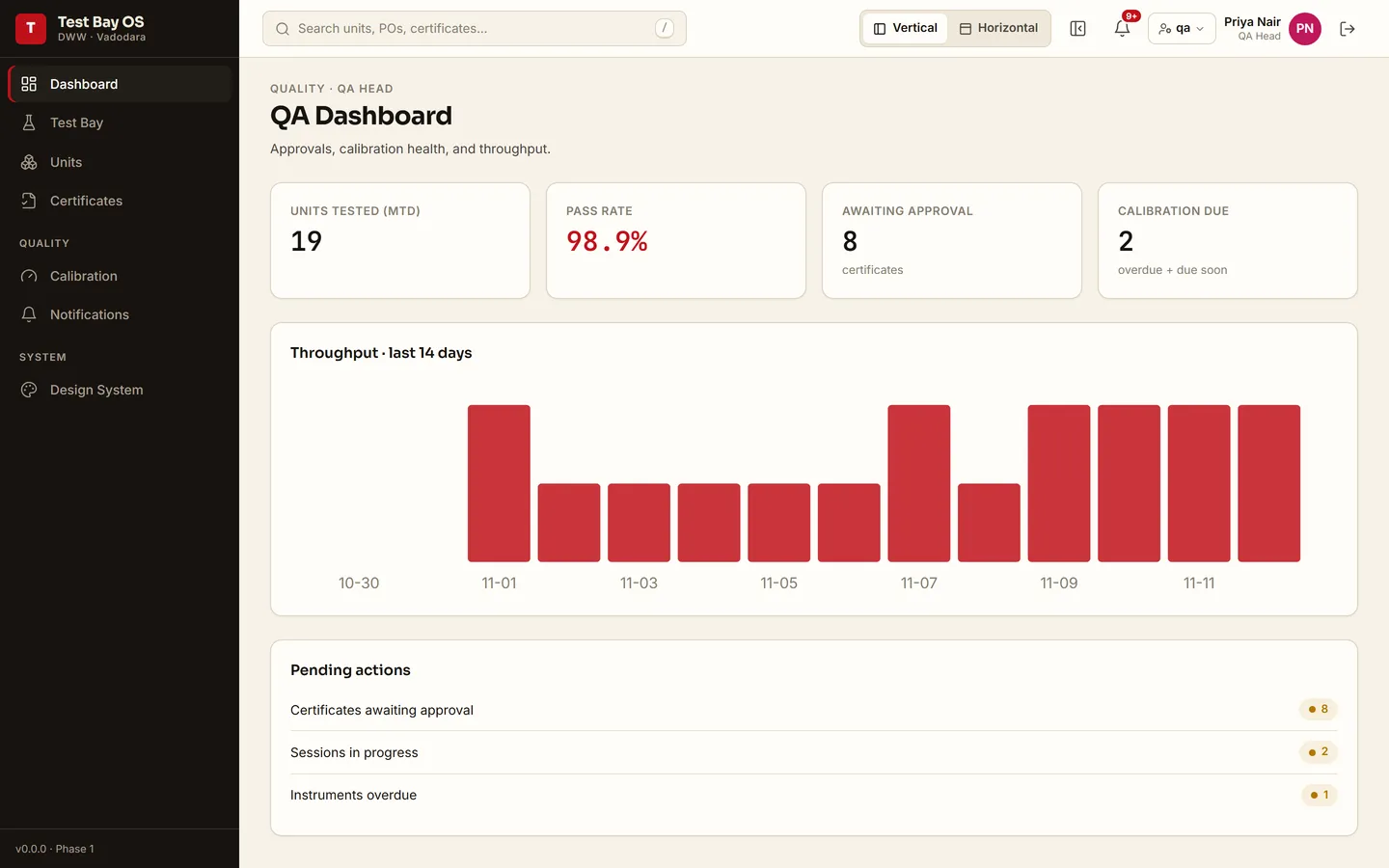
Four roles, four dashboards
Test engineers land on their bay queue, QA heads on approvals, pass rate and throughput, owners on plant KPIs, and admins on users, instruments and audit activity. Admins build test plans per transformer type, manage customer certificate formats, branding and numbering, and import units in bulk.
The interface is bilingual in English and Hindi for shop-floor staff, and works from a phone to a wide desktop.
- English and हिन्दी
- Audit log of every action
How it is built
| Layer | Technologies |
|---|---|
| Web app | React 18, TypeScript, Vite, Tailwind, TanStack Query, Zustand |
| Mobile app | React Native and Expo, on-device SQLite with an idempotent sync outbox, NativeWind |
| API | Node 20 and Fastify, Prisma with PostgreSQL 16, 105 REST endpoints, a typed client generated from zod schemas through OpenAPI |
| Background jobs | BullMQ on Valkey for AI register scans and PDF rendering |
| AI & documents | Claude vision for handwriting extraction; Handlebars templates rendered to PDF in headless Chrome with Playwright, HMAC-signed with a QR code |
| Monorepo | Turborepo and pnpm: API, web and mobile apps sharing the standards engine, schemas and design tokens |
Security and multi-tenancy
Each manufacturer's data is isolated in the data layer: a Prisma middleware scopes every query to the request's tenant, so isolation never depends on the client. Passwords use argon2id, access tokens are short-lived with rotating refresh tokens, two-factor sign-in is optional, every route checks permissions on the server, every request is validated, and the AI upload and sign-in endpoints have tighter rate limits.
Engineering quality
109 unit tests and a golden-data suite check the standards engine against worked examples, 31 end-to-end scripts exercise the running API, and 143 numbered requirements are traced to the phase that delivered them. Each phase had acceptance criteria and a recorded test before it was marked done.
Status
Test Bay OS is feature-complete and ready for pilot, after ten delivery phases and a hardening pass.
Our role
Digital Web Weaver did the requirements, UX and visual design, the standards engine, the web and mobile apps, the API, AI integration, the certificate engine, security and the infrastructure.
// testbayos-case-study.faq.md
Test Bay OS case study FAQ
Can't find yours? Ask us directly — we reply within 24 hours.
Still deciding? Talk to a senior engineer.
No sales script — a real technical conversation about your project, free.
What is Test Bay OS?
Test Bay OS is a multi-tenant SaaS for transformer manufacturers, built by Digital Web Weaver. It records every routine and type test for oil-filled, dry-type, cast-resin, CT, PT and reactor units, judges each reading against the governing IS or IEC standard as it is entered, and produces a numbered, signed, QR-verifiable test certificate in the customer's own format.
Which standards does it check readings against?
IS 2026, IS 1180 (star-rating caps), IEC 60076 parts 1, 2 and 3, IEC 61869-2 and -3 for instrument transformers, IEC 60270 for partial discharge, IS 335 / IEC 60296 for oil and IEC 60060-1. There are 22 evaluators, and every verdict cites the clause and the computed limit.
Does the AI decide whether a transformer passes?
No. The AI only reads the handwritten register photo and proposes values with a confidence score. Those values are judged by the same deterministic standards engine as typed readings, and an engineer confirms them before they count.
Can tests be recorded without internet in the test bay?
Yes. The React Native tablet and phone app caches units and test plans, runs the whole session on the device with the same standards engine, and syncs through an idempotent outbox when the connection returns.
How does it handle instrument calibration?
Each instrument has a calibration due date and NABL certificate on file. An overdue instrument cannot be selected when a session starts, and the certificate prints each instrument's calibration status as it was at test time.
Can you build software like this for our factory?
Yes. Test Bay OS shows how we build engineering software end to end: rule engines, offline mobile apps, AI document reading, PDF certificates and a secure multi-tenant SaaS. Tell us about your process and get an itemised plan and fixed quote within 24 hours.
you@dww:~ $ ./plan --factory-software
Testing or QA still on paper? Let's fix that
Tell us how your factory tests and certifies today, and get an itemised plan and fixed quote within 24 hours.
IS/IEC rule enginesOffline mobile appsAI document reading