
Case study · our own SaaS product, live at nivasgate.com
NivasGate: society software from the gate to the accounts
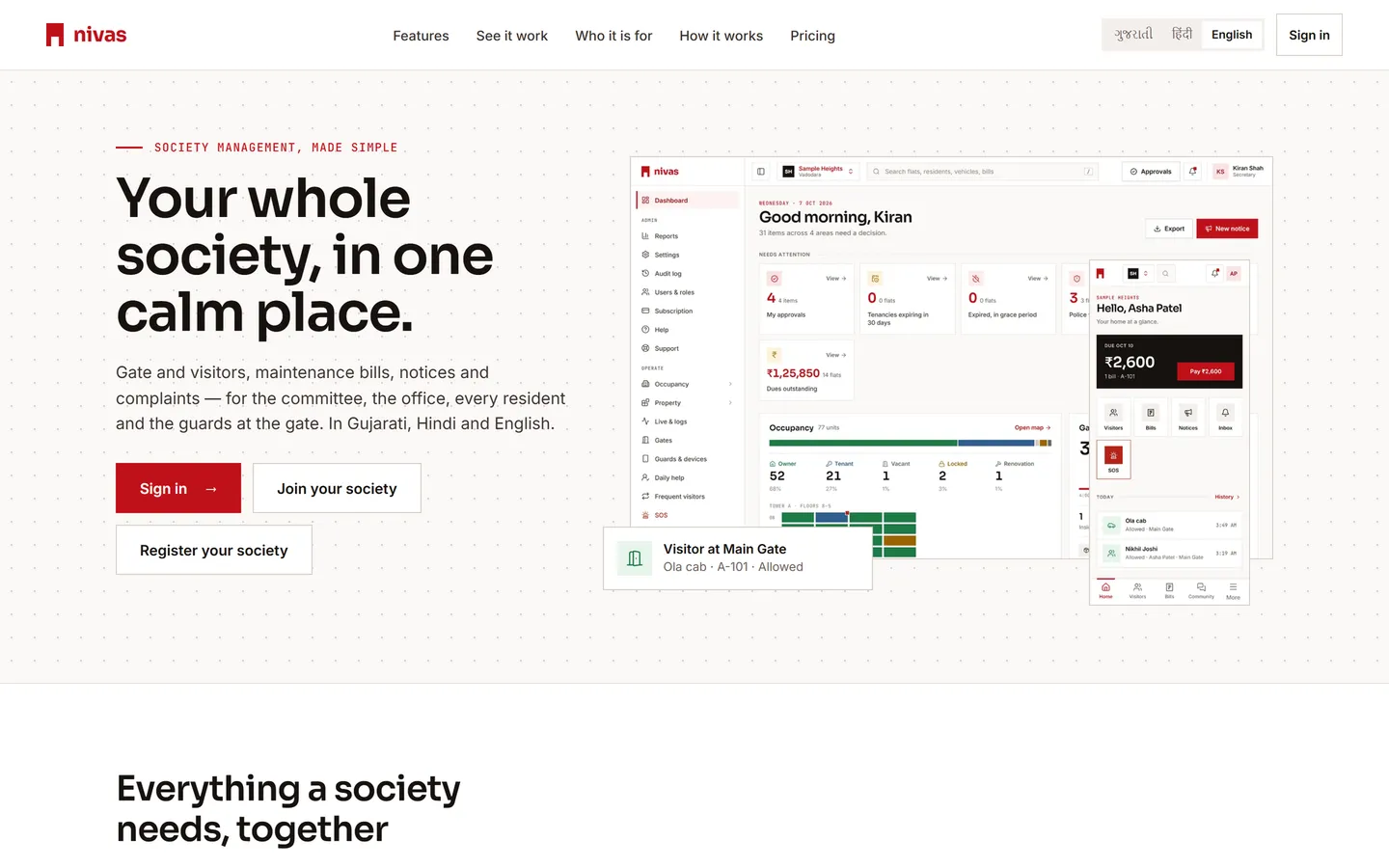
Most Indian housing societies run on a visitor register, a WhatsApp group, an Excel sheet and a notebook. NivasGate replaces all four with one product: a guard tablet app, a phone-first resident app and a full web dashboard for the committee, in Gujarati, Hindi and English. The first society using it is in Vadodara.
In short
NivasGate is a multi-society SaaS for Indian housing societies, designed and built by Digital Web Weaver and live at nivasgate.com. It covers visitor approval at the gate, owner and tenant records, maintenance billing with UPI paid into each society's own account, double-entry society accounts, notices, polls, complaints and SOS, in Gujarati, Hindi and English, for ₹10 per flat per month.
// the problem — a register, a WhatsApp group and a notebook
What societies were living with
Visitors let in by habit
A guard rings a flat, nobody answers, and the visitor walks in anyway. The register can't say who entered last Tuesday.
Nobody sure who lives where
Owner or tenant, since when, whether police verification was done, whether the agreement has expired.
Maintenance chased by hand
Bills go out late, reminders depend on one person's memory, part payments get lost, and the treasurer rebuilds the books at year end.
Decisions lost in chat
Notices, complaints and approvals drown in WhatsApp groups, with no record of who decided what.
Apps that sell to residents
The big apps push ads and charge residents for a premium tier, and most are English-first though guards and many residents aren't.
// what we built — nothing approved automatically
One product, from the gate to the accounts
Screenshots show a demo society, "Sample Heights". All residents, vendors, amounts and messages in them are made up.
01 · Gate
A guard app that needs no training
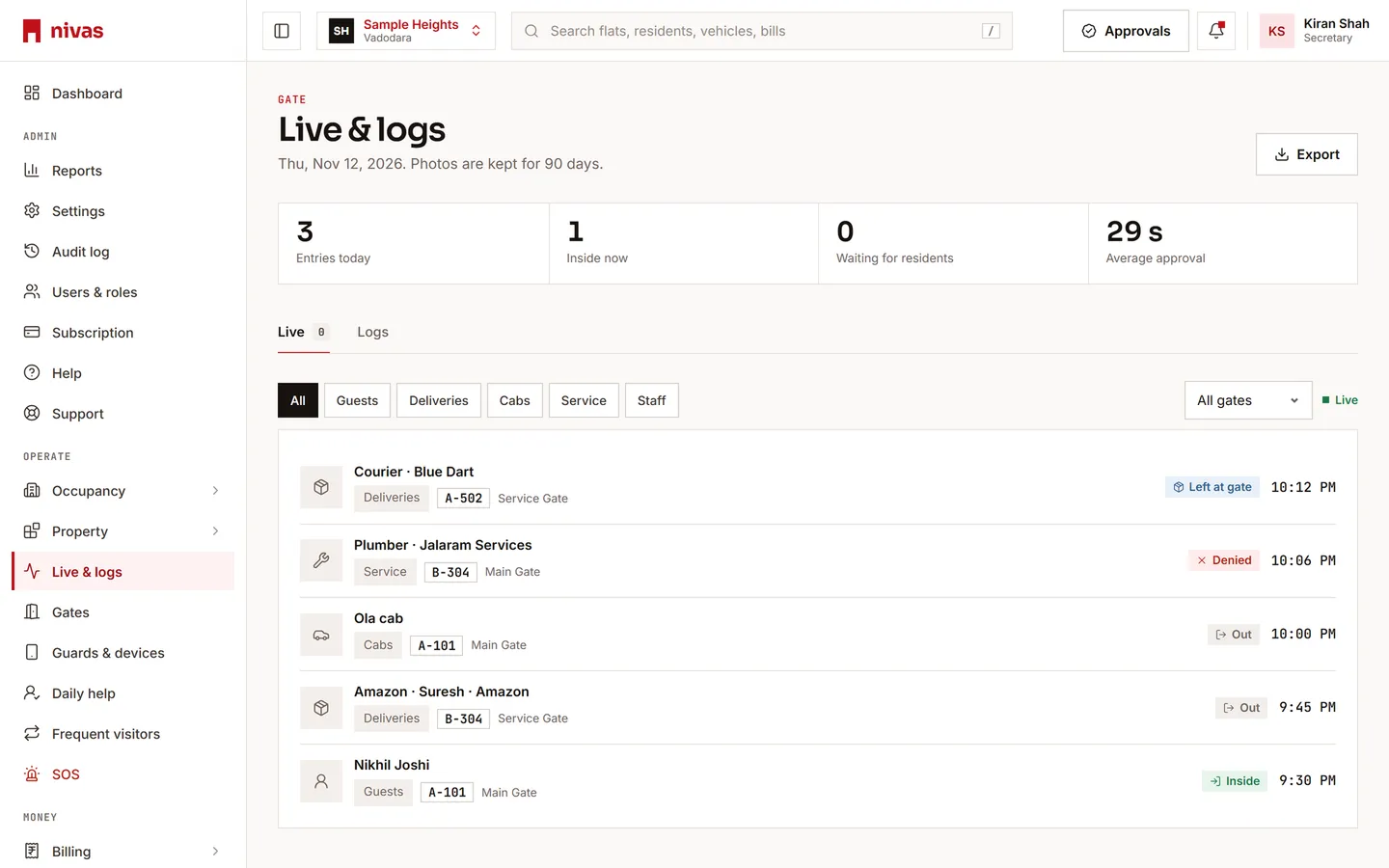
Pick the visitor type, pick the flat, take a photo, send. The guard app runs full-screen on a tablet, signs in with a PIN and keeps working when the network drops.
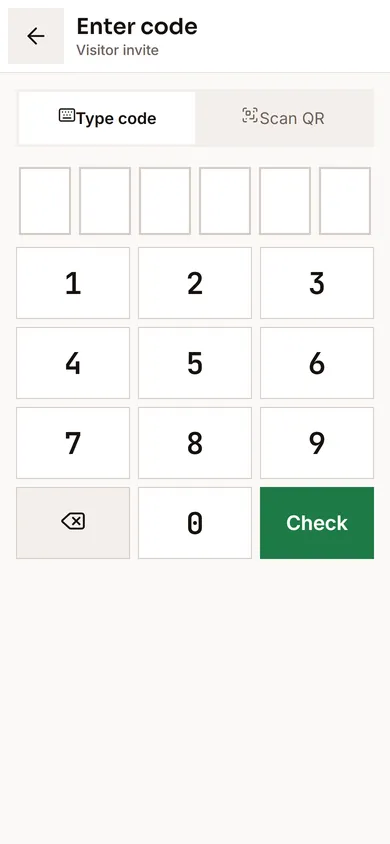
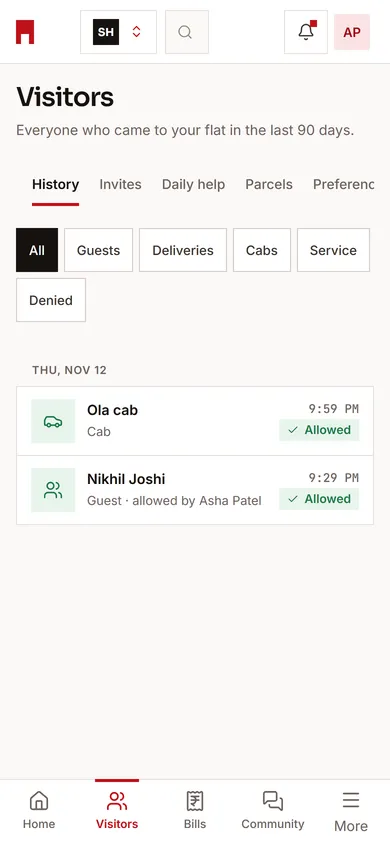
The resident gets a request with a chime; if nobody answers it escalates to WhatsApp, then a phone call, and the guard sees every step. Residents can send guests a 6-digit code or QR in advance, daily help get their own passcodes, and parcels are handed over only against a 4-digit OTP.
- No auto-approve, ever
- Invites, passcodes and parcel OTPs
- Entry photos kept for 90 days
02 · Homes & people
Every flat, owner and tenant on record
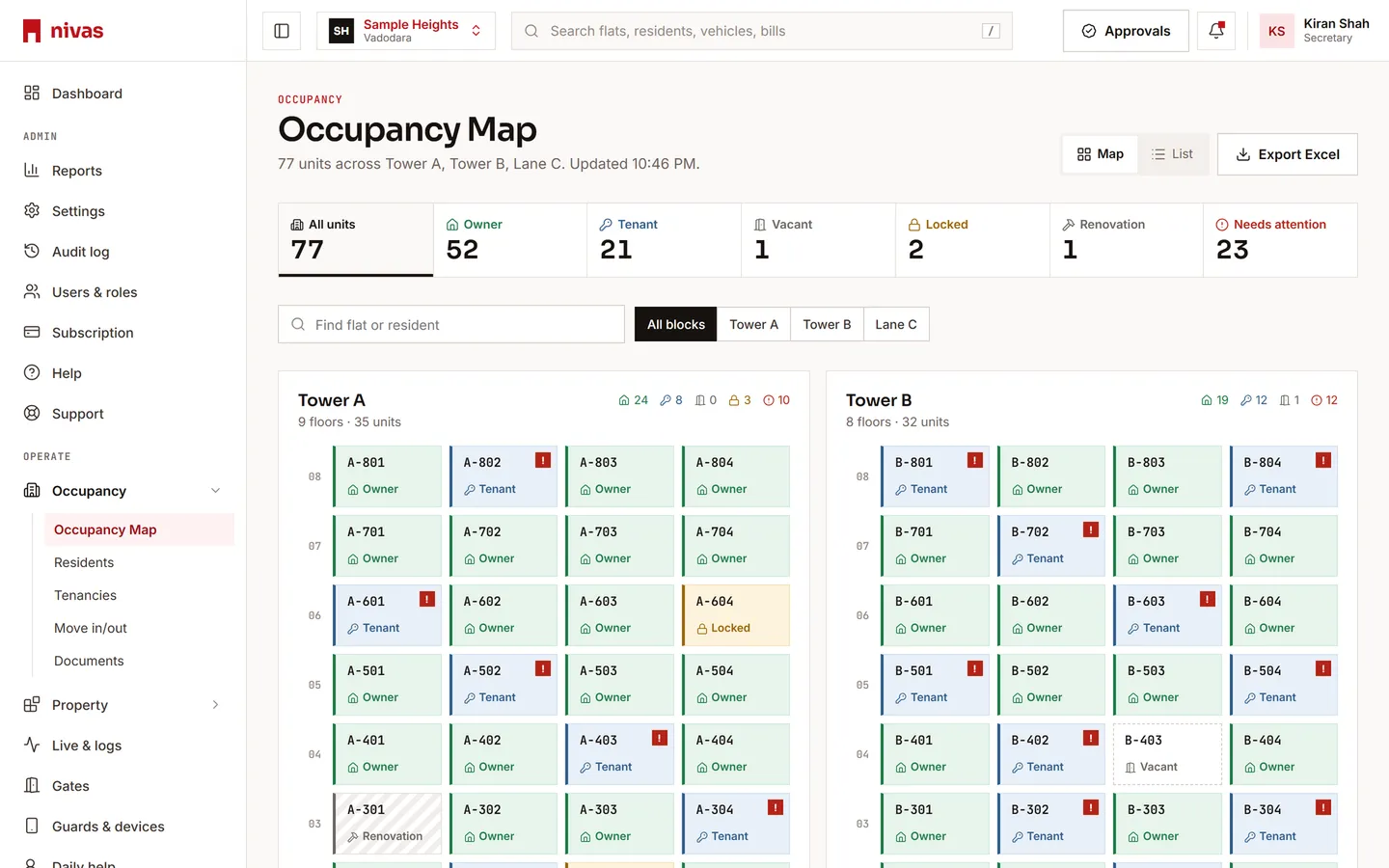
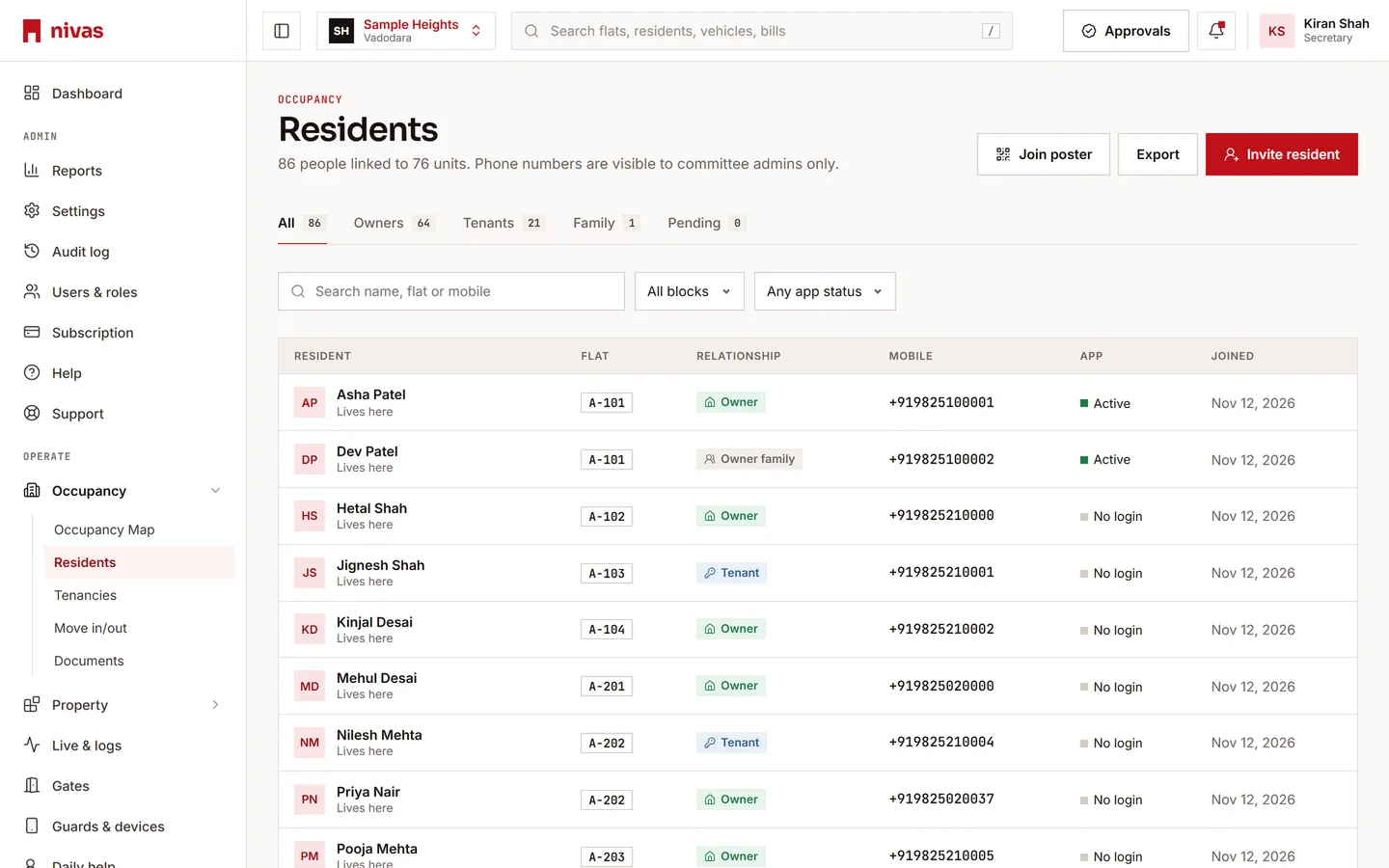
An occupancy map shows every tower, floor and flat coloured by owner, tenant, vacant, locked or under renovation. Residents and tenancies carry agreement dates, police-verification status and expiry alerts, with contact and ID details masked unless a role may see them.
Flats are set up in minutes or imported from a spreadsheet, documents are kept per flat with a verify step, and move-in and move-out requests go on a weekly calendar so a move never blocks the service lift by surprise.
03 · Billing & collection
Maintenance that collects itself
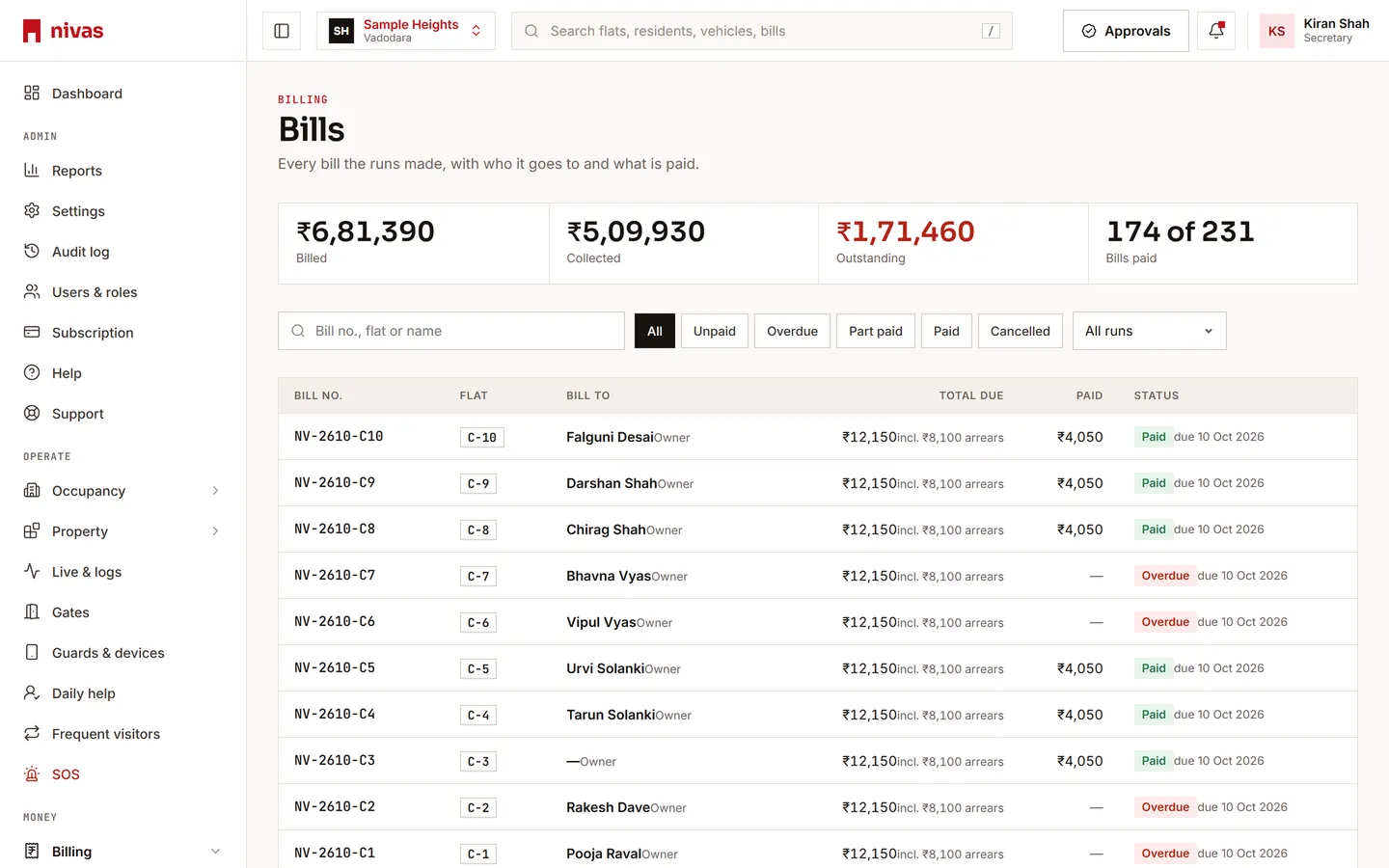
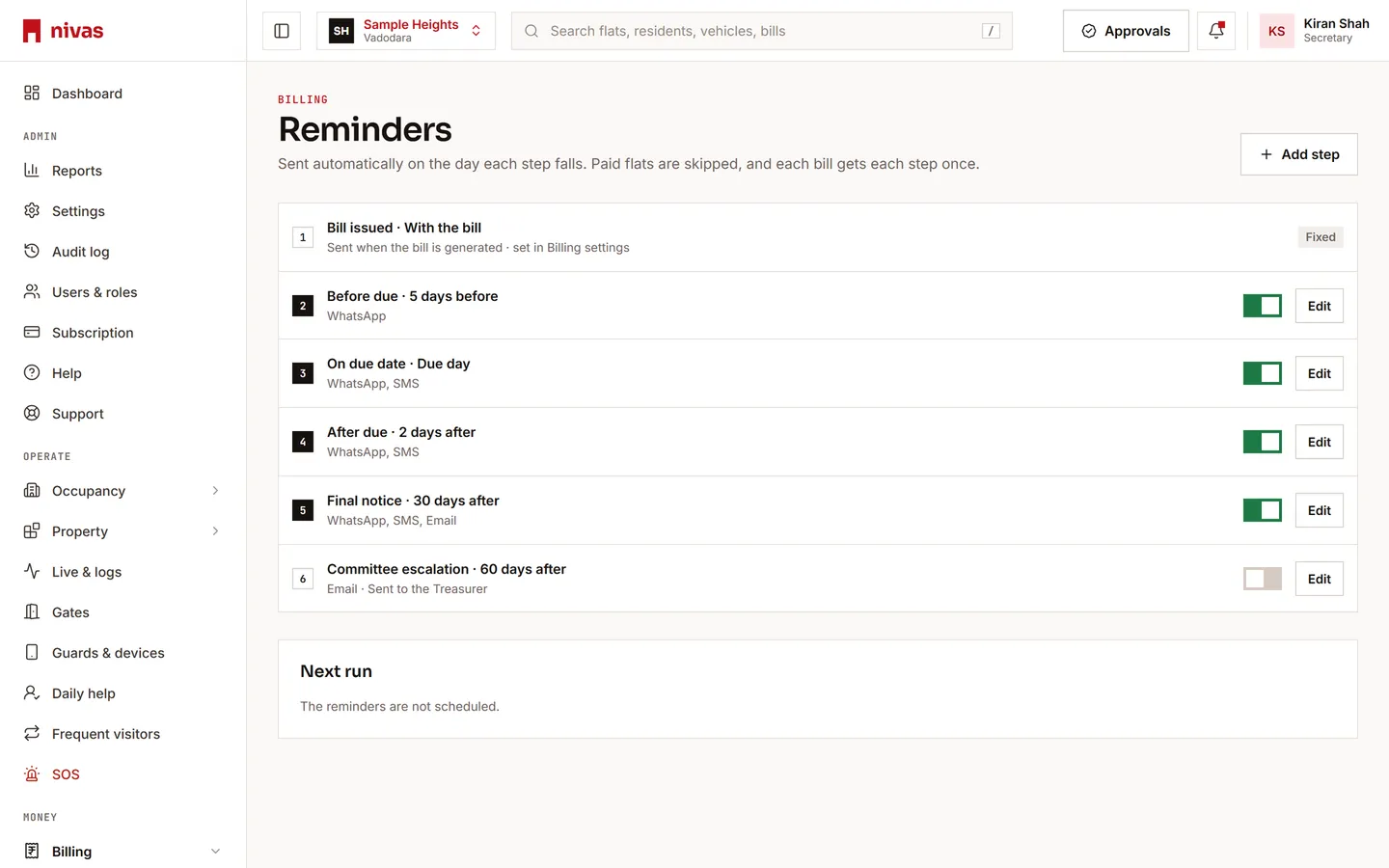
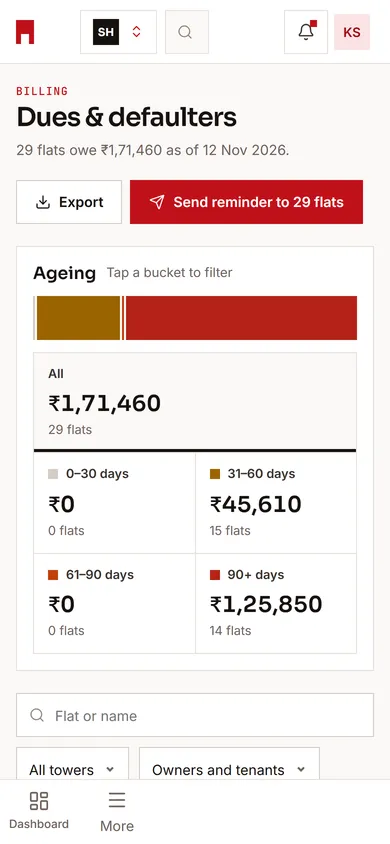
Charge heads by area or per flat, a monthly bill run with a preview, and bill and receipt numbers that never skip. Dues are shown by age, and a reminder ladder runs by itself on WhatsApp, SMS or email, skipping flats that have paid.
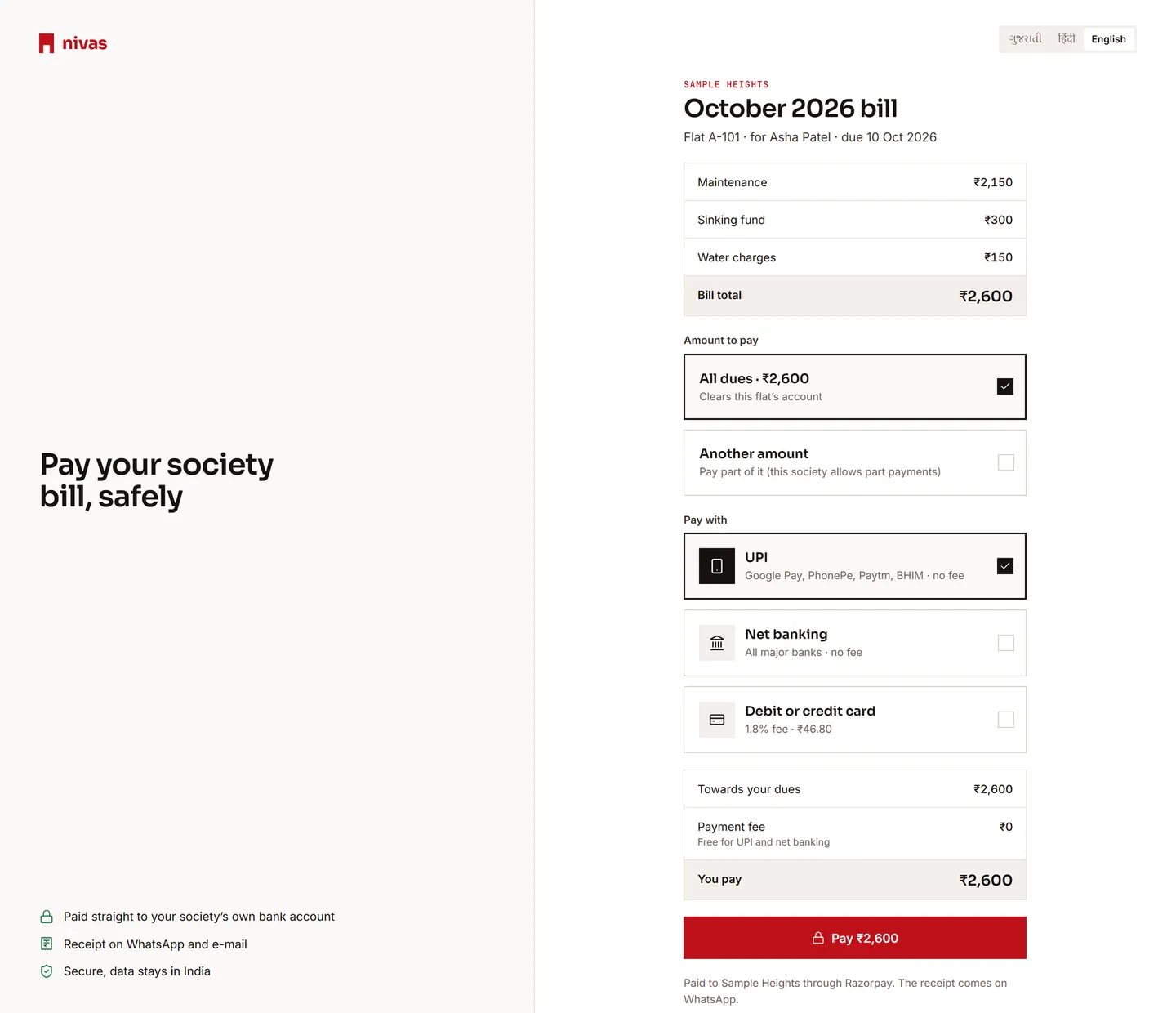
Every bill carries a link to a public pay page with UPI, net banking and card, paid into the society's own gateway account. Residents can upload proof of a cheque or transfer, or approve UPI AutoPay once. Payment plans, committee-approved waivers, instant no-dues certificates and bank reconciliation are built in.
- Money never passes through us
- UPI AutoPay with notice before each debit
- Bank and gateway reconciliation
04 · Accounts
A real double-entry ledger from day one
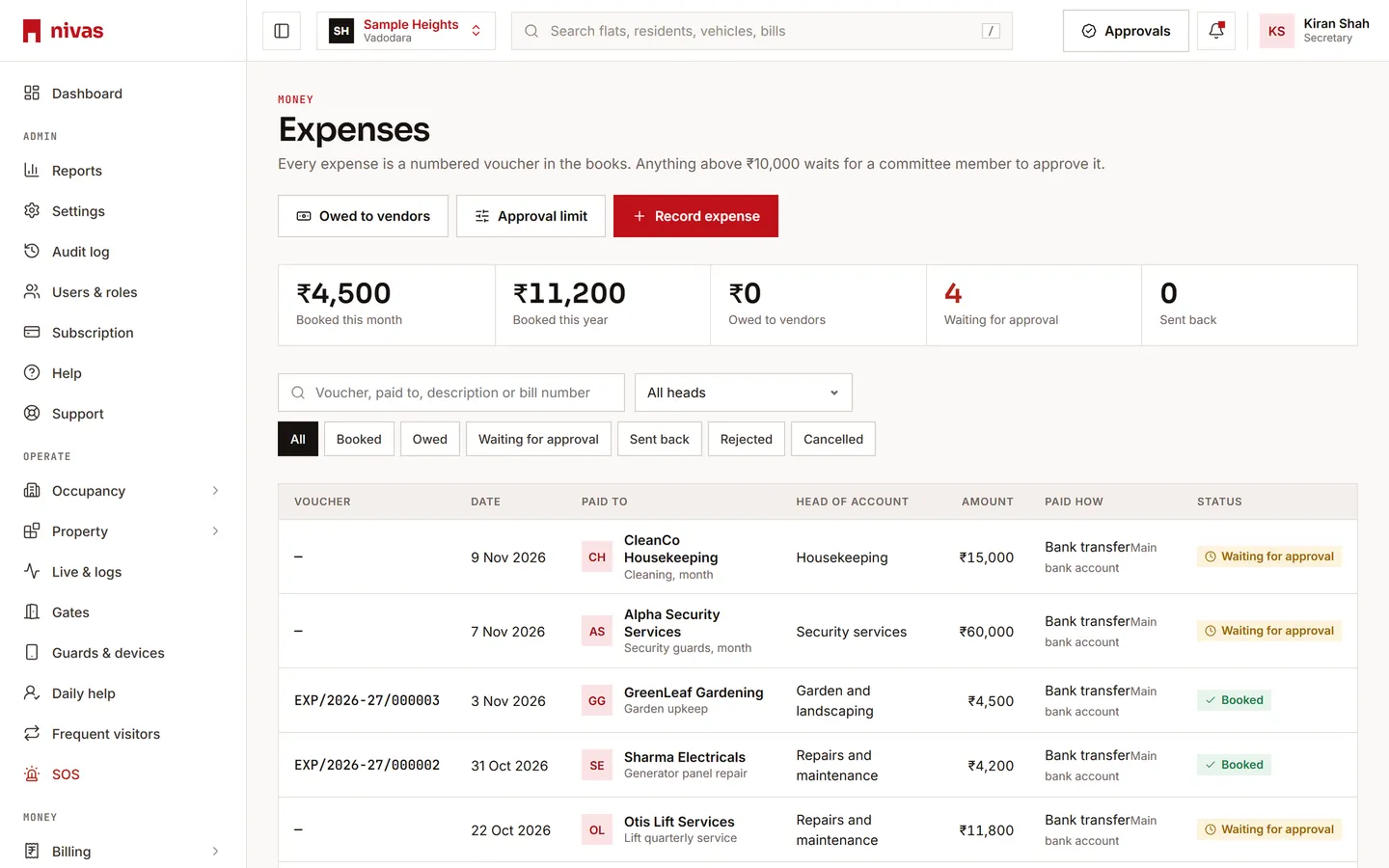
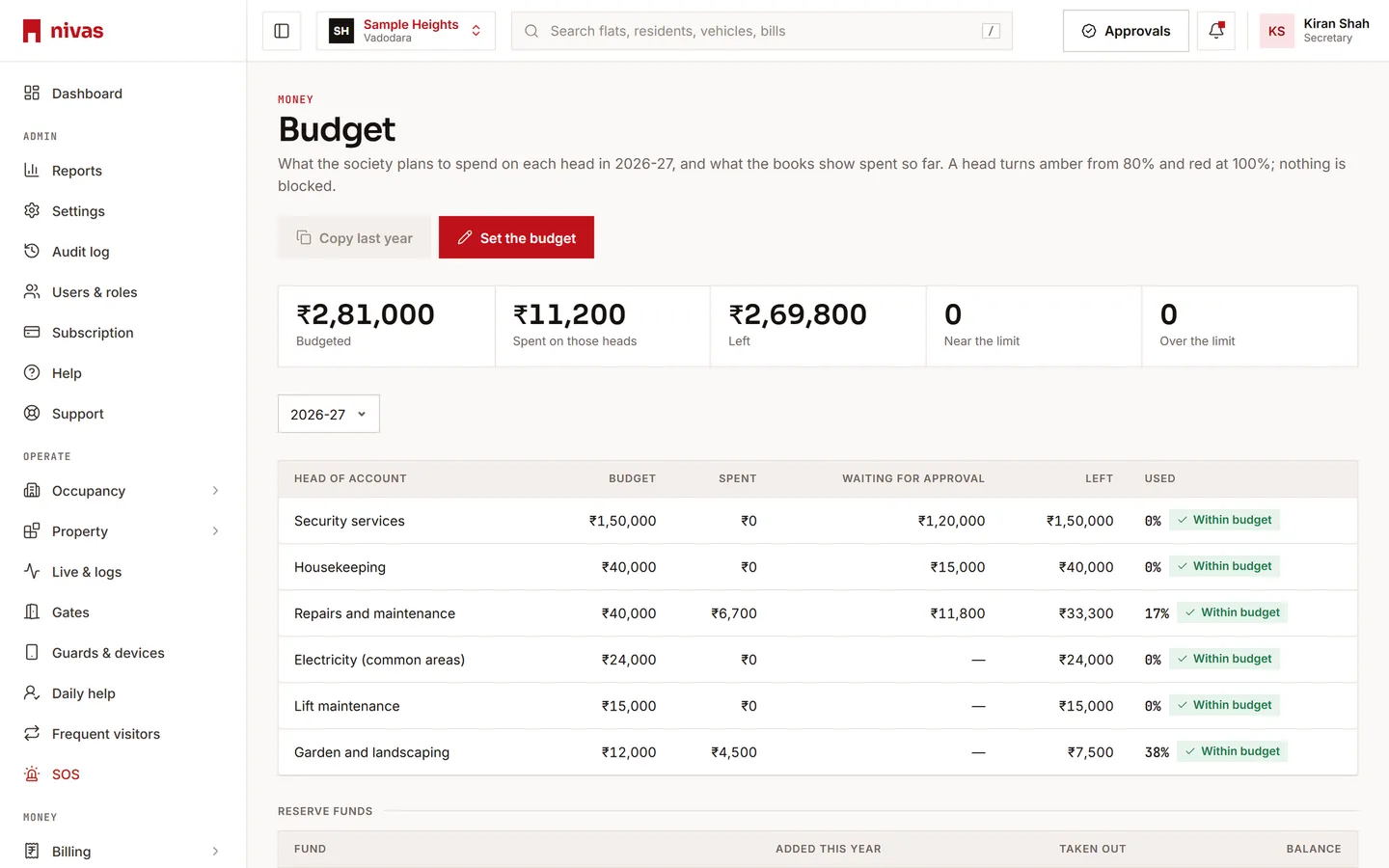
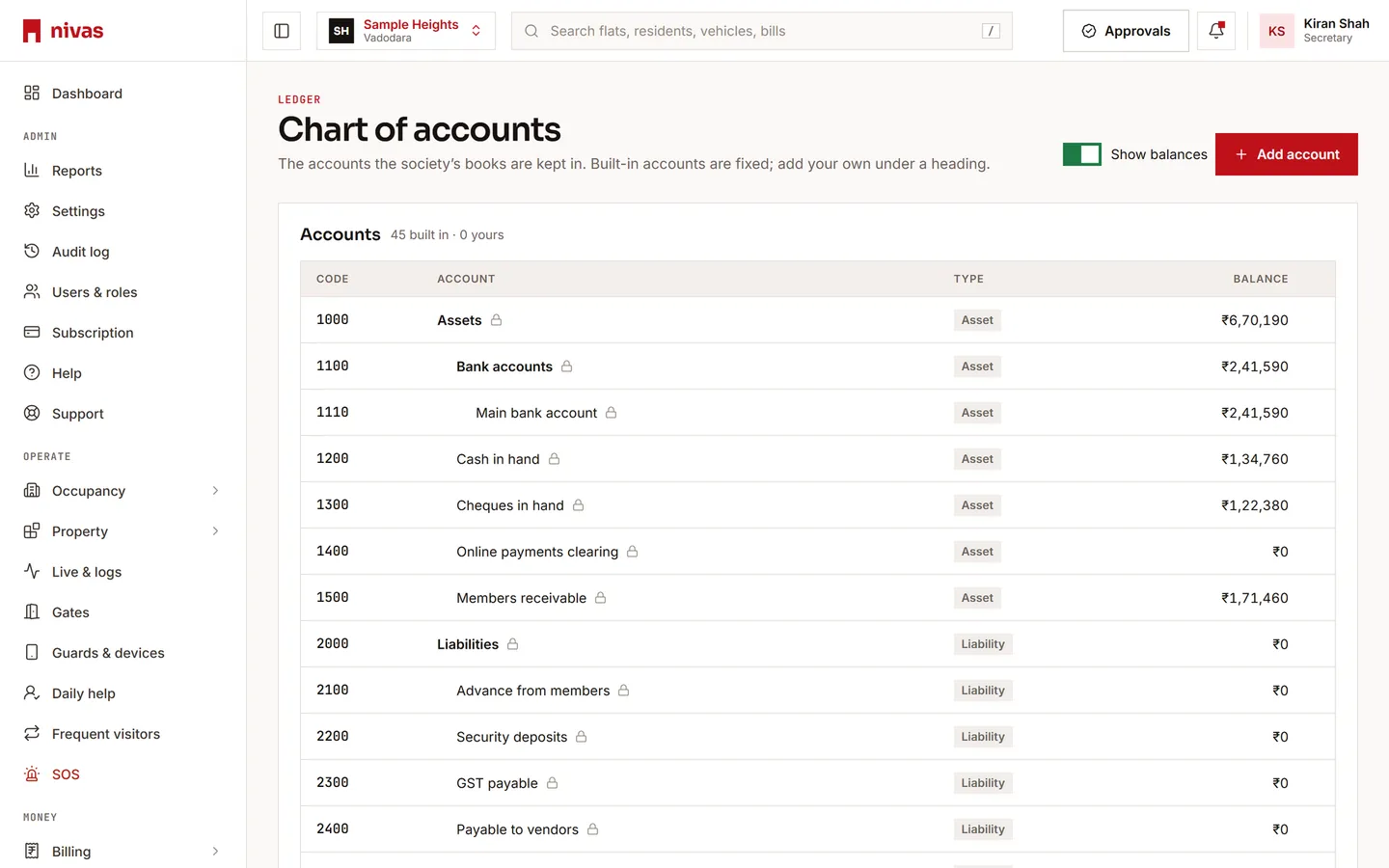
Everything is posted to a double-entry ledger, so the dashboard, the bills and the statements always agree. A chart of accounts with society heads built in, numbered expense vouchers that wait for committee approval above a limit, vendor payments with TDS, budget against actual, and contract renewals.
Trial balance, income and expenditure, balance sheet, receipts and payments, day book and cash and bank book come out of the books directly, with a year-closing check and a Tally export for the accountant.
- Vendor PAN and bank details encrypted
- Thirteen exportable reports
- Tally export
05 · Community & safety
Notices, polls, complaints and SOS
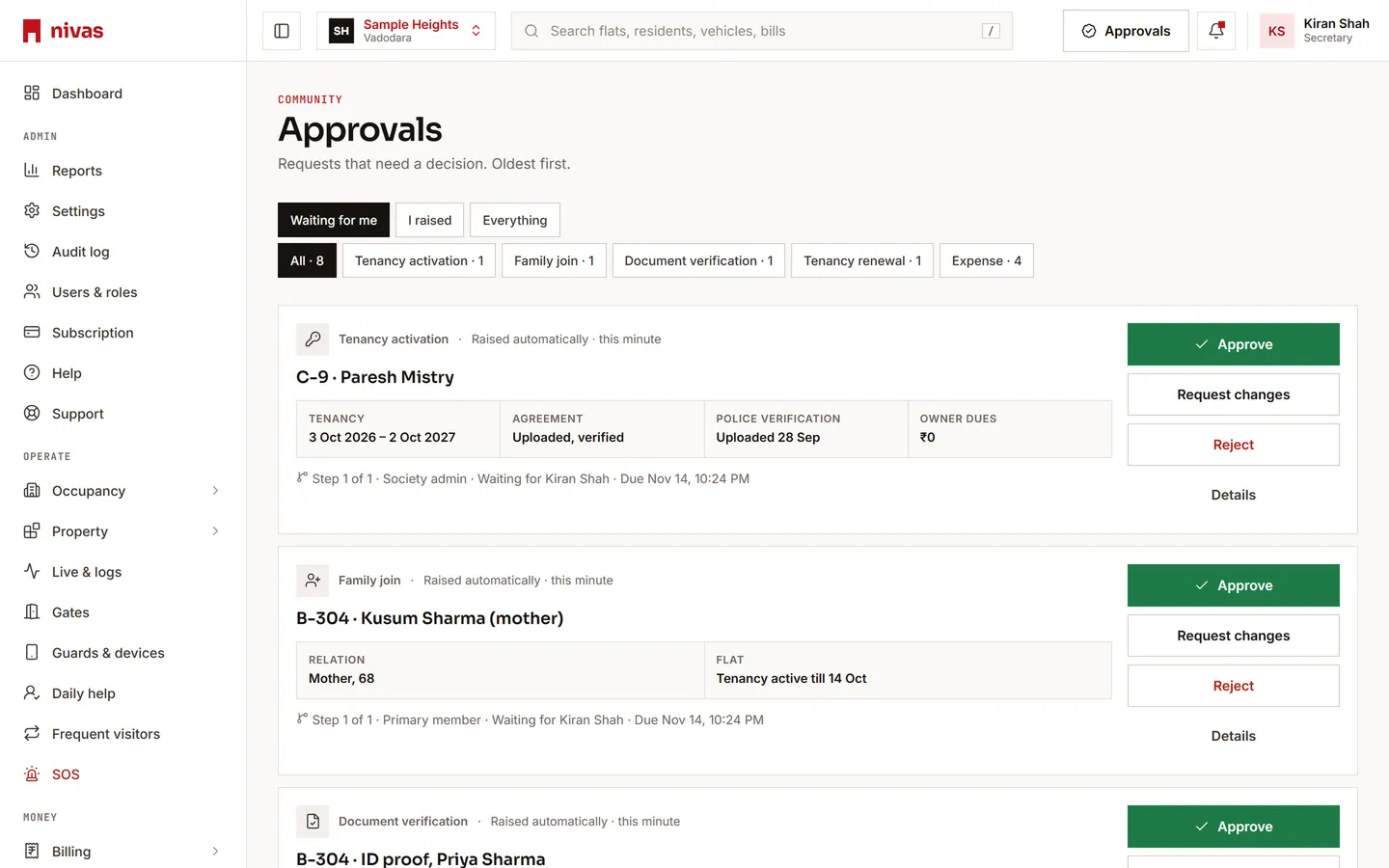
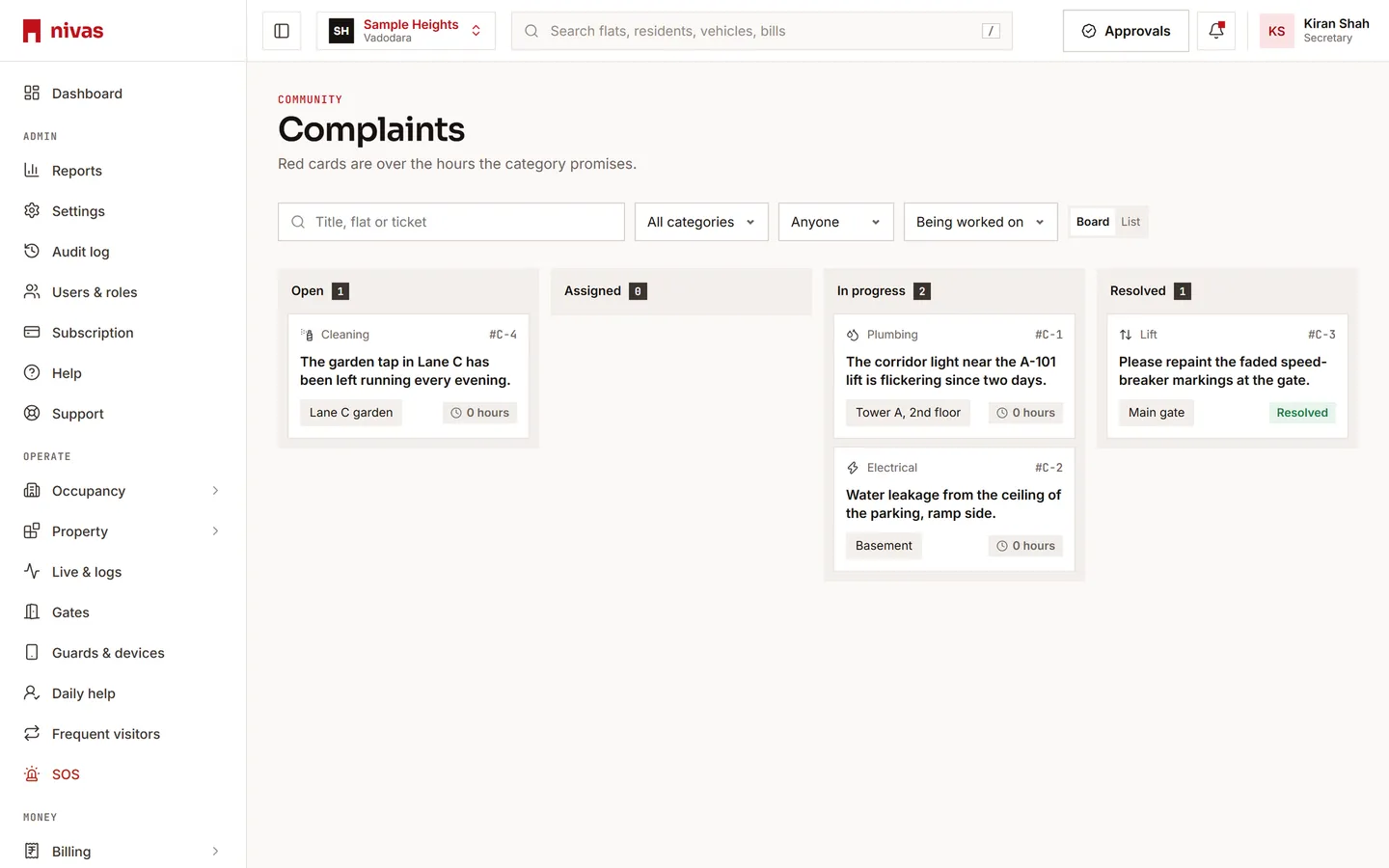
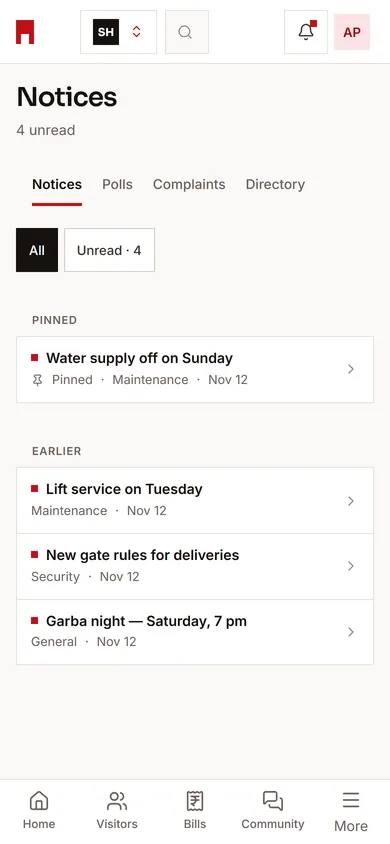
Notices go to the app and to WhatsApp or email and show how many people each reached. Polls count one vote per flat or per person and publish a result. Complaints move across a board with response times and automatic escalation.
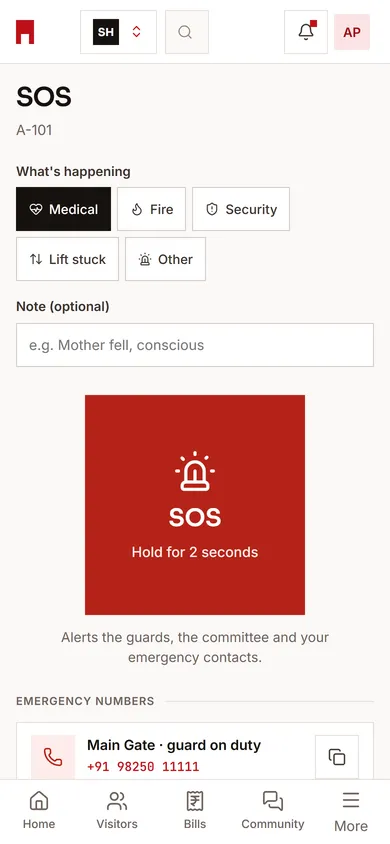
A resident holds the SOS button for two seconds and picks medical, fire, security or lift stuck; the guards and committee are alerted with the flat and time, and the guard's screen turns red until someone acknowledges it.
06 · Phones
The committee doesn't need a laptop
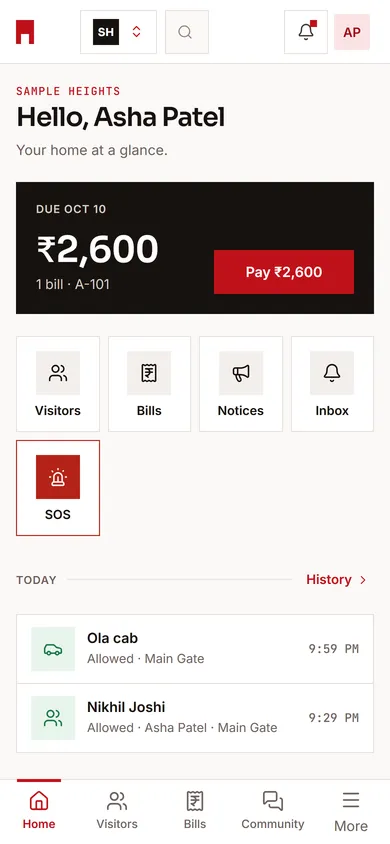
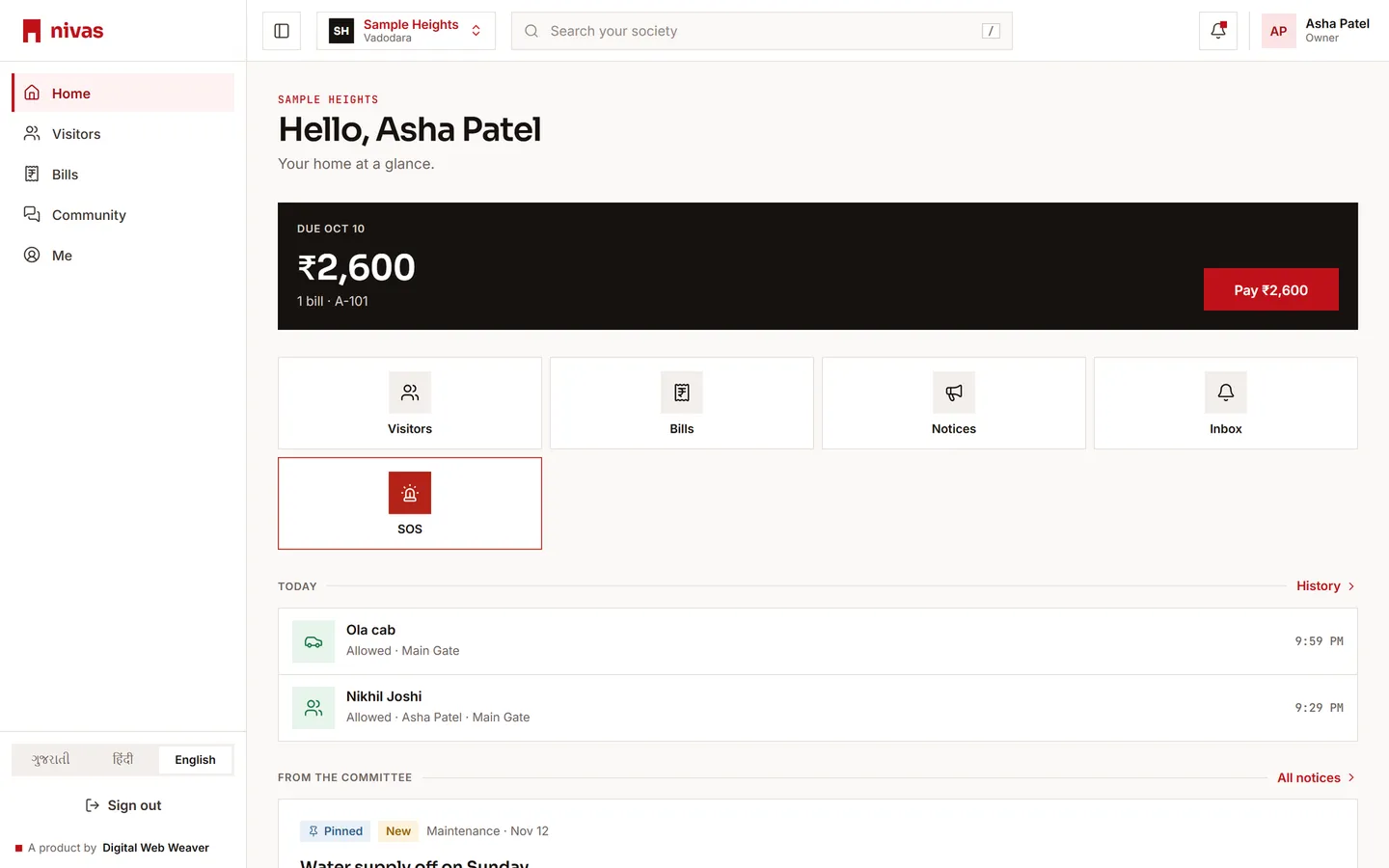
Below 1024 pixels every page switches to an app layout with a bottom tab bar and tap targets of at least 44 pixels. On each release an automated check visits every page at desktop and phone widths and fails if anything scrolls sideways. Residents can raise the text size, and switch between Gujarati, Hindi and English at any time.
07 · Front door
A website that signs societies up
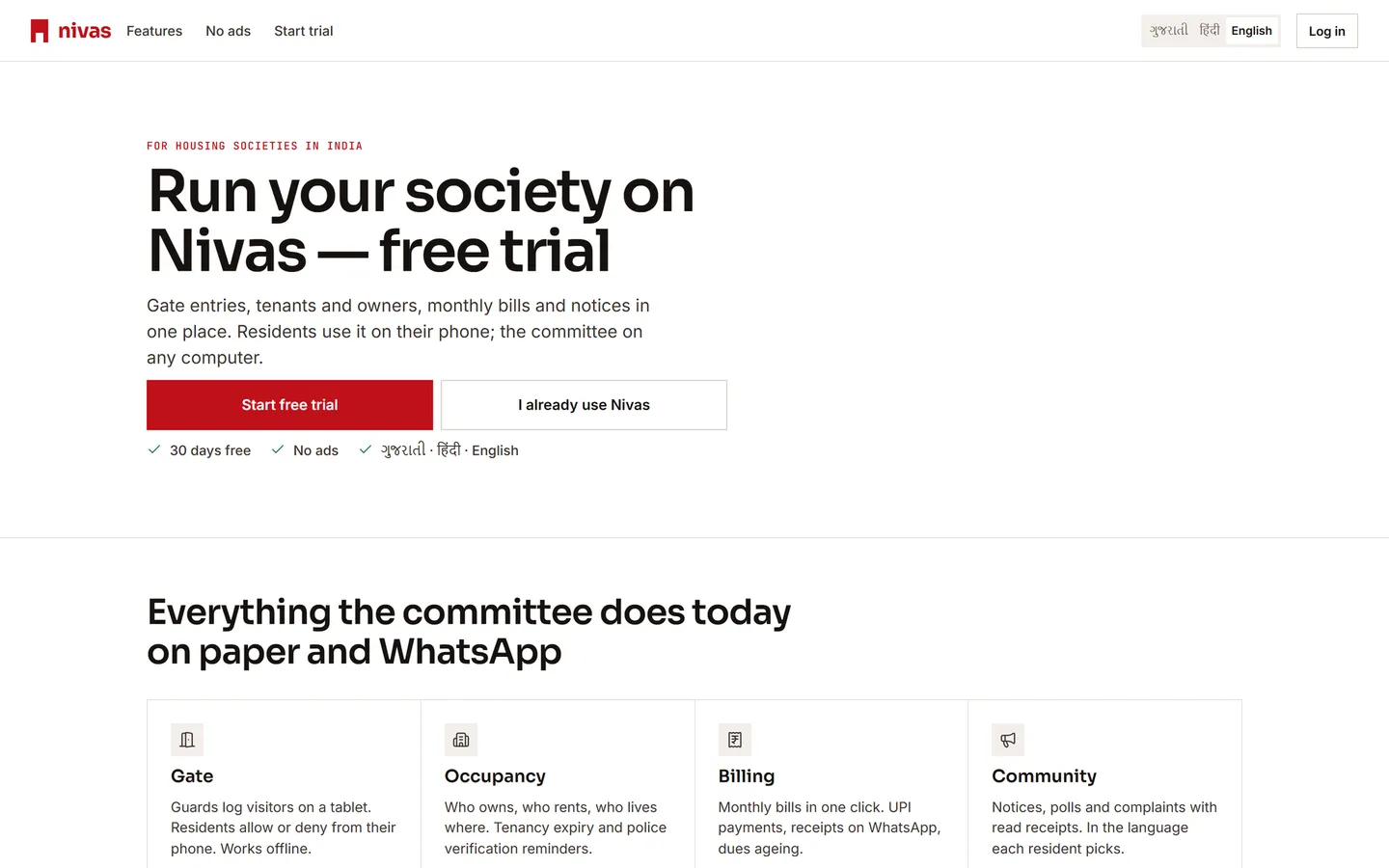
The public site explains the product, shows it working on mock devices and lets a society register itself in five steps: details, blocks and flats, documents, plan and consent. The platform team reviews the request and approval builds the society from the answers.
One plan for everyone: ₹10 per flat per month plus GST, a 30-day free trial, no ads and no paid resident tier. The landing page loads only a few kilobytes of text first and the fonts were cut by half, so a first visit on a mobile connection is quick.
// multi-society SaaS
Many societies, one installation
Data kept apart in the database
PostgreSQL row-level security with composite tenant keys and forced RLS, and a test on every society table proving isolation.
Organisations
Builders, facility-management companies and security agencies manage many societies from one login.
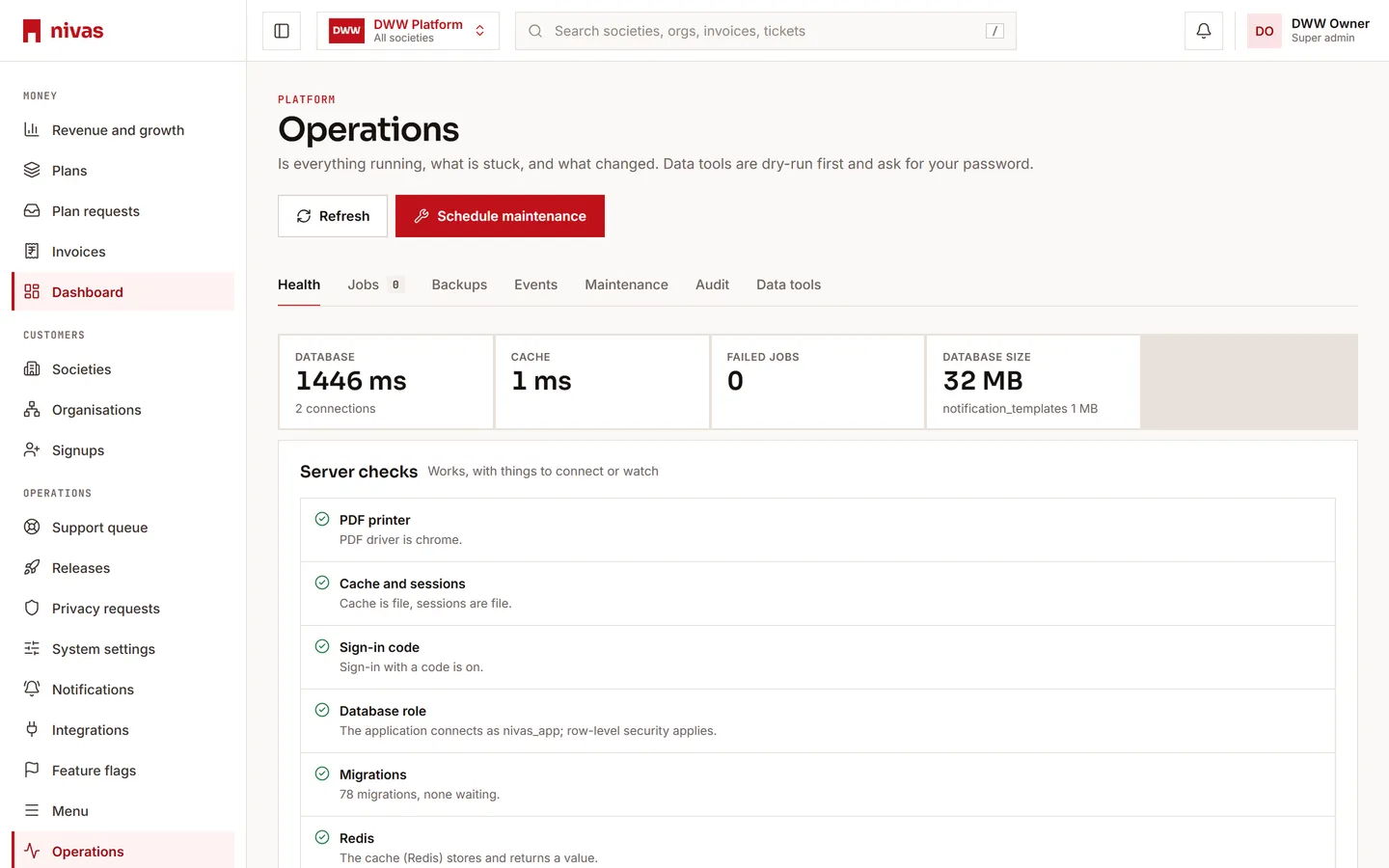
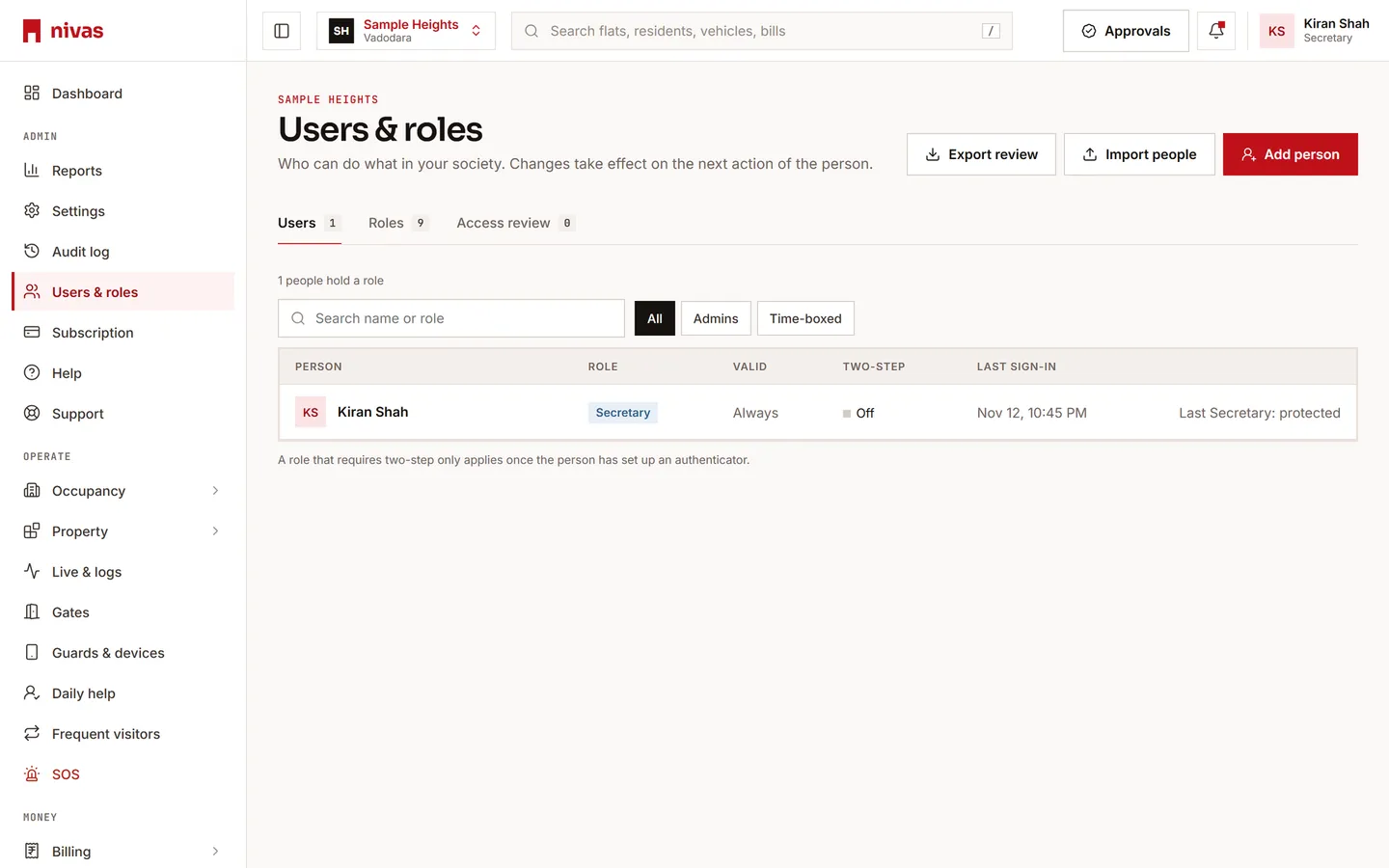
126 permissions
Nine ready-made society roles plus organisation and platform roles. Top roles must use two-step sign-in.
Settings, not code
100+ settings, feature flags for gradual releases, and a vault for provider credentials.
About 90 notifications
Each in three languages, through the inbox, push, WhatsApp, SMS, email and voice.
Built for the DPDP Act 2023
Recorded consent, a privacy centre to see and export data, an audit log, and guards who never receive phone numbers or documents.
Technology
| Layer | Technologies |
|---|---|
| Web app | React 19, TypeScript, Vite, Tailwind CSS 4, React Router, TanStack Query and Table, Zustand, React Hook Form with Zod, react-i18next, Chart.js |
| Apps | Resident and guard apps as installable PWAs (service worker, offline guard, web push) from the same code |
| Backend | PHP 8.3, Laravel 13 modular monolith (21 modules), Sanctum, permission and workflow engines |
| Database | PostgreSQL 18 with row-level security, composite tenant keys and forced RLS; UUIDv7 keys; money as whole paise |
| Cache & queues | Redis |
| Payments | Razorpay with each society's own keys, UPI AutoPay |
| Messaging & documents | WhatsApp, SMS, email, push and voice through pluggable providers; server-side PDF bills, receipts, certificates and statements |
| Quality | Pest, Vitest, Playwright at desktop and phone widths, an architecture test for module boundaries, a UI audit that crawls every page |
| Delivery | pnpm and Turborepo monorepo, zero-downtime releases with health check and automatic rollback, nightly verified backups and a monthly restore drill |
In numbers: 21 backend modules, 78 database migrations, 640+ API operations, 150+ screens, 100+ designed prototypes, 1,100+ backend tests and 560+ browser tests, about 8,100 text strings in each of 3 languages and 700+ numbered requirements.
Our role
Digital Web Weaver owns NivasGate end to end:
- Product research, requirements and the approval and money rules
- UX and visual design, including a prototype for every screen
- The web, resident and guard front ends
- The API, the database and the double-entry ledger
- The permission, approval and notification engines
- Security, privacy and data-protection design
- Payment integration and reconciliation
- DevOps, backups, deployment and the marketing site
// nivasgate-case-study.faq.md
NivasGate case study FAQ
Can't find yours? Ask us directly — we reply within 24 hours.
Still deciding? Talk to a senior engineer.
No sales script — a real technical conversation about your project, free.
What is NivasGate?
NivasGate is a multi-society SaaS for Indian housing societies, built and owned by Digital Web Weaver and live at nivasgate.com. It covers the gate, residents and tenancies, maintenance billing and collection, double-entry society accounts, notices, polls, complaints and SOS.
Is any visitor approved automatically?
No. Every visitor is a decision a resident makes. If the resident doesn't answer the app, the request escalates to WhatsApp and then a phone call, and the guard sees each step.
How is each society's data kept separate?
By PostgreSQL row-level security with composite tenant keys, not only by application code, and every table that holds society data has a test proving one society can't see another's.
Does payment money pass through Digital Web Weaver?
No. Each society uses its own payment-gateway keys, so maintenance payments settle directly to the society's own bank account.
Can you build a product like this for us?
Yes. NivasGate shows how we build SaaS end to end: research, a prototype for every screen, web and installable apps, ledger and payment logic, security and deployment. Tell us your idea and get an itemised plan and fixed quote within 24 hours.
you@dww:~ $ ./contact --saas-product
Building a SaaS product of your own?
We take products from research to a multi-tenant platform in production, the way we built NivasGate. Tell us your idea and get an itemised plan and fixed quote within 24 hours.
Fixed-price quotesSenior engineers onlyMulti-tenant SaaS